The Virgin & the Whore Walk Into a Bar

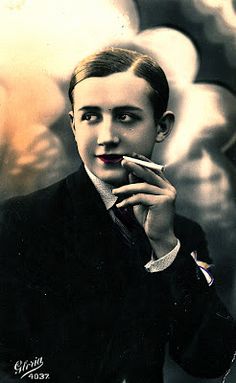
Modern daguerreotype. Image courtesy thedaglab.com for The VIrgin and the Whore Walked into a Bar post by Malin James

Modern daguerreotype courtesy The Dag Lab

As you can see, I haven’t posted here in awhile. This isn’t from laziness or lack or commitment. Rather, it’s the product of a happy fact–I’m super busy with work on the other side of my career, (that would be the smutty side, for those who don’t know). Posts on this blog will probably be fairly sporadic for the next little while, or at least until I finish the massive project that is my novel. That said, they will pop up as I can manage. In the meantime, you can take a peek at what my erotica writing alter ego, Malin James, is up to here. Or not.. It’s totally up to you.

Which brings me to the virgin and the whore. I’ve always loved that paradox, mostly because I’ve always felt like both–the virgin and the whore, I mean. I am equally comfortable eating ice cream with my daughter and writing articles about the death of the Dewey Decimal System, (this is a greatly contested death, FYI), as I am doing and writing any number of things that I’m not going to mention here because my mother reads this blog. Of course, you can always check out the following to get a sense of what I mean: link, link, link. Click at your own risk.

There’s a common notion that a person is one particular thing–a mother, a teacher, a daughter, a parent, a slut, a virgin, a whore…you get the picture. I would contest this notion though. I think that, much as Meredith Brooks sang in her song, “Bitch,” (what a rockin’ good title), most of us are both sinners and saints. It’s only when we get too attached to one static identity that things get complicated and often unfulfilling.

Yes, I’m a mother and, I hope, a good one, but that doesn’t mean I can’t write things that would make my own mother supremely uncomfortable, (sorry mom–definitely don’t click those links). It doesn’t mean that I can’t have an identity outside of motherhood that many might find unorthodox at best, and somewhat distasteful at worst.

After years of wrestling and apologizing, the fact is that there’s a lot of dark in me–there’s anger and sex and rage and violence. But there’s also a lot of light. I’m nurturing and empathic. I’ve got compassion on tap. These things should be in violent contrast. They shouldn’t be able to coexist, and yet they do, quite naturally, in me, just as they do in most people. All you have to do is choose the two, (or three, or four), contrasting archetypes that resonate with you.

Of course, nothing is never as simple or easy as that. But that’s sort of my point–personalities aren’t static things. They are constantly in motion, acting and reacting. Really, when it gets down to it, personalities are simply a series of reactions, habituated over time. So, the virgin and the whore are part of who I am, and it’s only in cultivating both of them equally that I can truly be whole.

I wanted to give a quick, but very sincere thank you to Eric Mertens at The Dag Lab for letting me use one of his beautiful images in this post. You can see more of his work by clicking here. Mr. Merten does old-fashioned daguerreotype portraits in his lab in Oakland, CA. The work is gorgeous. Please, go check it out. 

On Style in Prose

Letter & CoffeeI’ve been writing for about 11 years now, and I can honestly say that it’s only been in the past 2 that I’ve begun to find my style… Or rather, styles, because I have several – it just depends on what I’m writing.

For the first 8 years of that 11, I was terrifically preoccupied with finding “my style”. What I didn’t realize at the time was that you have to be able to write first. Hemingway didn’t start off sounding like Hemingway. You can see hints of  Papa’s style in his early novels, but his authorial voice was still in the developmental stages until it peaked with “The Killers” and “Hills Like White Elephants.” Unfortunately, Hemingway also demonstrates the danger of being too wedded to any one style – later in his career, he fell off the ledge into self-parody… Please don’t hate me fans of Hemingway.

What I failed to realize as a young writer is that, in much the same way that a teenager is a human work in progress, a new writer isn’t fully formed until she gets some experience, (i.e.: shitty stories and lots of rejection), under her belt. The idea that I would have to live through tons of rejection, and that every story I wrote for years would be nothing more than a learning experience terrified and daunted me 11 years ago. Luckily, I’m incredibly stubborn…and I really love to write. So I plowed ahead through all that shittiness until my writer-self began to grow up.

It was a long and painful process – not just for me, but for the people who valiantly read 10th, 20th and 25th revisions, (I’m not kidding), of a stories that were never going to work – not because I’d used the work “enamored” twice on one page, but because the damn things just didn’t have a plot. It took awhile to figure that out, (sorry valiant people), but as soon as I did, things started to fall into place.

And that’s when I realized that a writer’s style is really just a reflection of the writer’s personality. Very often it’s surprisingly subtle. Word choice is part of it, sure, but even more than that, it’s the quirks and humor and punch and flow that form your sentences. It’s the way you turn a phrase. It’s the “sound” of your writing, the rhythmic rise and fall in your tension and pacing – that’s not something you can force, nor is it something you can develop on purpose. It just has to come. In other words, don’t ask the caterpillar how it walks – it’ll trip all over itself. Just let the little guy do his thing.

When it comes down to it, style is just one more lens through which to read a writer’s work. And yes, it is important. That said, it’s also something that works itself out. You don’t need to worry about finding it – if you give it enough time, it will find you.

On Burning Your Boats

When I decided to move to writing full time, I did so with the caveat that if anything really promising in librarianship came up, I would do it and write part-time again, which means that my choice to write full time was always, in some way conditional – I had a sort of mental escape hatch that allowed me to do the frightening thing and write while still feeling like I had a safety net.

About two months ago, I was approached about a contract position in a library, which definitely qualified as “something exciting”. On the surface, the opportunity made a lot of sense. It was a part-time situation that would net a decent, very stable income and replace the worry and comparative instability of freelancing. Score. I would work in the library part time and write part time. The family schedule would be “interesting” (meaning INSANE), but it overall, that would be okay because everything else would be good… except for the fact that I would lose some traction on current WIP’s and projects… and that  the idea never quite settled right with me. At all.

Last week interviews and phone meetings were scheduled for the position. This week would basically be spent talking to people and deterring the terms of the contract. Should have been exciting, right? But it wasn’t. I just felt vaguely sick. I couldn’t focus on the writing I had to do – I was too preoccupied by the fact that soon I would have far less time to work.. meaning write.

So, after much debate, I just sent a series of very nice emails saying thanks but no thanks to the contract. You’d think that torching that safe little boat would be empowering or, at the very least, kind of fun. It wasn’t not. It was very gently terrifying, because it meant that now I’m doing this. No safety net. No back-up. This is it. I’m a writer – not a writer on condition – and that means I need to up my game and kick some serious ass. Seriously.

On the flip side, it feels good to have a challenge to rise to. I’ve never done the safe thing, though it’s never been from lack of trying – safe was always a siren song, even as I auditioned for play after play, all while trying to figure out how to be an actor *and* have a stable, routine life. Ha.

It was that trying to be safe that kept the risks I took from paying off. Now, for the first time in my life, I’m taking an unabashed, no-holding back risk. And I’m free – from myself and the little demon that whispered in my ear. Be safe. Be safe. Be safe. 

Sometimes, safe isn’t really that safe, not if it isn’t honestly safe, and my pursuit of safety, and my inability to see a risk through was never honest. It was always based in fear. So now, my boats are finally burning and that little safety demon can go straight to hell. In declining the contract position, I finally sent it there, and that does feel good.

Portrait: Jean the Ambiguous

I love androgyny. I always have – from Marlene Dietrich in a tux to David Bowie in anything – androgyny is beautiful to me. It’s been a while since I posted a bit of fiction, so I dug into the archives, (i.e.: the ancient, dusty files on my hard drive), and unearthed this character study. After a bit of dusting off, I remembered by I’d written it – I rather love Jean. In fact, Jean will very likely end up in a story of Jean’s own. In the meantime, however, here’s a sketch of the fabulous Jean, who defies the constraint of labels and gender. 

Jean the Ambiguous

androgenous jeanOne can only begin to description of Jean by saying that Jean is French. Though Jean’s nationality has little practical bearing on Jean’s personal behavior (aside from a certain pronounced flair), the fact the Jean is French factors into a separate, pivotal, matter—the interpretation of Jean’s name. Or, to put it more succinctly, the choice of pronoun one uses reference to Jean.

You see, the French spelling of “Jean” is not “gender specific,” and neither, really, is Jean. If Jean were only English, (or American in a pinch), the ease of gendered spelling would see one through—“Jean” or “Gene”, “he” or “she.” The question of pronoun would cease to exist.

Ironically, the ambiguity of Jean’s name is a perfect reflection of Jean, which, though prickly to admit, is the root of the difficulty. One must also admit that a contributing factor is Jean’s stubborn (though admittedly suave) insistence on not offering any definitive evidence as to gender in either dress or manner. Allow me to clarify.

Jean is tall and slender – tall for a woman (though not unthinkably so) and quite average for a man. Jean’s hands are fine-boned, with long, rather sensitive looking fingers – Jean has the hands of a fine woman or an accomplished musician. Unfortunately, Jean’s income and fame are entirely due to the virtuosity with which Jean plays the violin, so there is little help there.

That’s all fine and good, you must be thinking, but one can surely tell a person’s gender from his or her manner of dress! In answer to this, I’ll admit that it’s true in most cases. But Jean’s manner of dress is unconventional for either sex—tailored suit with a flared coat; French cuffs and lovely jeweled links; a snowy white shirt with a ruffled front; dramatically high collar; crisply knotted tie. The lacquered longish hair adds to the confusion. Is Jean a woman with short hair, or a man with long? It’s impossible to tell.  The only thing one can say for sure is that Jean’s cologne, (or perfume), smells quite good.

So clothing is no help, and neither is bearing. There is always seduction in the large, smudged eyes; a feline smile on the pale, oval face. One moment, one is sure one has solved the riddle of Jean, only to see the picture change….

And so what is one to do? Ask leading questions? Jean smiles mysteriously, (or negligently or indulgently or flirtatiously), and one is dazzled but no closer to knowing which pronoun to use. And so the mystery continues, adding flame to the fire, and fueling the allure of the obsession that is Jean.

Note 3/16/14: Just this morning, I received the lovely news that this post was given the Gender-Bender Award by the lovely mind behind Tiffany’s Non-Blog. Needless to say, I’m quite honored that a character I’m so fond of turned someone’s head in such a wonderful way. Thank you so much!

gender-bender-award1

Agnes, The Maid

This is a short portrait / character sketch. Sometimes it happens that I get a character without a story. Usually it’s a character I quite like and will come back to later, either in their own piece, or as a tertiary character somewhere else. Agnes is one of these characters…

Agnes, The Maid

No one used a feather duster like Agnes. The command with which she wielded a batch of feathers shoved into a stick was truly terrifying. Even the mistress stayed

out of her way, not daring to test the sideboard after Agnes had been through.

Agnes was a narrow sort of woman, rather like an obelisk, with an air of authority that made her seem far taller than she actually was. Even as a child in the first blushes of youth, there had been little of the girl and even less of the blush about her. She was made of serious stuff. Lest you forget, the line of her mouth would remind you, before her shoulders squared off like a coat rack, and she took up arms against the dust.

Serious as she’d been as a girl, Agnes had had hopes – hopes that had been dashed quite early on in her career as a person. As a girl she had wanted to join the cavalry and go to war like her father, who’d been a sergeant in the Boer Wars. When her father had informed her that daughters did not join the cavalry, that this honor was only for sons, and that even if they did join the cavalry, his daughter would certainly not, Agnes had cried for hours. It was the last time in her life she would cry.

Finally, touched by his daughter’s rare show of emotion, Agnes’s father relented upon one nonnegotiable condition. If she were determined to go join the army, it would be the infantry for her. No “prancing about on ponies” – not for his girl. She would charge into war like a man. Though she was by no means un-heroic, the “ponies” had rather been the point. But her father would not be moved. She joined domestic service instead. Agnes never forgot her dream though. It was her one great disappointment. It would affect her, subtly, for years.

Despite her lowly role as maid, she wore her uniform with military precision. The sheer force of her personality endowed her ruffled cap with an air of authority, as if the cap knew itself to be overly frilly, and had tried to sharpen up. She took orders and conveyed orders with the bearing of a much older person. And, of course, the house had never been so utterly free of dust.

Agnes rose efficiently through the ranks to head housemaid after only two years, and it was assumed that when the housekeeper retired, Agnes would take up the helm. With the confidence of authority, Agnes felt this to be true. She was, after all, a nearly perfect servant. Her only flaw was the aggression with which she dusted the house. It called to mind a general, spitting on enemy armies before crushing them in his, (or her), wake.

Tank, or Gentleman Scholar

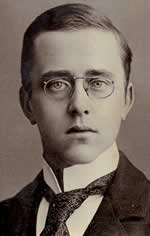
Image courtesy of http://en.wikipedia.org

If there were ever a man like a mountain, Tank was not that man. Physically, he was more of a molehill, though his intellect towered over men three times his size.

Upon his birth, Tank had very nearly been named Theodore for his mother’s favorite brother. But Tank’s father, in a rare burst of filial interest had insisted that he should name his son, and that his son’s name should be Tank, not for any particular reason, except, perhaps, that he’d been drunk.

Despite the name’s dubious implications, it had gone on the birth certificate, and so Tank had been “Tank” for the entirety of his life, save, in quiet moments, when his mother had coo’d “Theo” in his ear. It was the distant memory of his mother’s voice that sallied him through years of quizzical looks and disappointment, (on his father’s part, at least), for the fact that his physical prowess failed to match either his name or his mental acumen.

How he would have loved to be Theodore – perhaps then he wouldn’t have been quite such a disappointment. Theodore’s did not lay bricks for a living, nor did they brawl or curse or spit. Theodore’s sipped brandy in book lined rooms and thought important thoughts, pausing, only briefly, to write the most important ones down. Theodore’s became scholars and architects, and left the brick laying to men named Tank… though not this particular Tank.

In awesome defiance of his father (and to his mother’s quiet pride), Tank excelled academically. His first very good school led to a second very good school, which in turn led to an impressive university career. It was at university that Tank discovered, and pursed, his love of etymology.

Tank’s calling found him one afternoon, as he was researching his own name. It was indeed true that the verb form of “tank” meant “drunk,” and had since 1893, but the noun form held a special light of hope. In the original Portuguese (brought west by way of India in 1616, from the Gujarati “tankh”), the word referred to an underground reservoir of water, and it was to this idea of hidden depths that Tank held firm.

His desire for Theodore slowly waned beneath the weight of his etymological studies and academic success. By the time he published his magnum opus, a thirteen volume tract called simply, Names, Tank was at ease with himself and his once dubious moniker, signing notes of thanks for various scholarly offers and congratulations, With Most Cordial Regards, Dr. Tank McGuinness.

Let Me Know You: On Pseudonyms, Erotica and the Public / Private Divide

nude on bed

I write erotica under a pseudonym. Many authors writing in this genre do. It wasn’t until recently that I considered why that might be.

When I first started writing erotica, I took a pseudonym for two reasons. The first was down right frivolous – I thought it might be fun. The second, and far more practical reason, was that I freelance in a number of different markets and the pseudonym would allow me to keep the two halves of my writing career separate.

I suspect that, for the majority of authors, the use of a pseudonym is equally practical. Many writers have primary careers that would be negatively affected if the sexual nature of their writing were to become known. People expect their teachers, therapists, and doctors to be morally squeaky clean. Patients do not want their gynecologists to write erotica on the side. Erotica, though mainstreaming, is not yet above reproach.

In addition, the moral / ethical concerns mentioned above can, at times, extend themselves into an author’s private life, particularly when the writer’s parents, children or partner might be negatively affected. No teen-age boy wants his friends to know that his mom “writes porn,” and a father’s custody could be contested if his career as an eroticist were brought to light in court. As a result, it’s easier for many erotica writer to allow the nature of their work to remain selectively ambiguous. Ours is not a widely respected genre, after all.

There is a lot to say about the stigma associated with reading and writing erotica, a genre that is, for many, still negatively associated with historically pejorative terms like “porn”, “smut”, and “dirty story.” Despite the fact that these labels are being slowly reclaimed by those who read and write in the genre, the stigma still remains. There is quite a lot to say about why this might still be true, but I will resist the impulse to digress and, instead, focus on one, specific point, and that is how my pseudonym – the ubiquitous accessory of pornographers, eroticists and writers of dirty stories everywhere – has come to function for me.

Allow me to begin with what my pseudonym is not.

My pseudonym is not an apology for what I do. It is not a way to distance myself from what I write. I am proud of my work in this genre, and I am equally proud to be part of a community of writers that displays a level of causal curiosity that is admirable in an openly cynical age.

What my pseudonym is, is two different things. It is an invitation and a boundary; it is a welcome and a wall. It provides me with an identity that can be publicly shared, while remaining separate from my own. It gives me a persona to extend to my readers, while allowing me to both maintain, and transcend, the public / private divide.

Invitation. Wall.

Why, as a writer, would I need such a thing?

Because when you write about sex, particularly intentionally arousing, fictional sex, people react, often more viscerally than they would to content that is not quite so sexually explicit. My pseudonym invites the reader (or public) to engage and connect with my work, while allowing my non-public self a certain degree of anonymous privacy.

There is a long-standing assumption about writers. The assumption is that, however unlikely, an author’s work must be, in some way, autobiographical. In my experience, this assumption is heightened with eroticists. After all, our work is inherently sexual and very often kinky, edgy or taboo. We write sexual fantasies with the express purpose of arousing the people who read them. Because of this, the perceived intimacy of autobiography, when it arises, can be particularly intense.

For most readers, this perception of intimacy is not an issue. They read a story, they enjoy the story, they move on to the next story. There is, however, a small minority of readers who crave access to the writer beyond the limits of the page. They want the personal connection they made with a story to extend to the author who wrote it.

Some time ago, a reader contacted me in a manner that can only be described as overly attached and profoundly curious. This reader had connected, romantically and sexually, to a story that I had written and published under my pseudonym. He confessed that he wished to gain deeper, truer access to the woman who had written it; he wanted to share my mind and, somewhat chillingly, my “soul”. This reader, caught in the illusion of sexual intimacy that the story had created, wanted exclusive access, not to what I had written, but to me.

What’s more, this gentleman had constructed around my work and pseudonym, a persona that he desperately wanted to believe in – that of the sophisticated vixen and dominant mistress who would grant privileged access only to him. It was a fantasy that he’d spun with no input or encouragement from me, save for the story that I’d written and that he, in turn, had read. This is when my pseudonym became more than a pithy solution to a professional problem. This is when it became a wall. It gave this man something to attach to, without attaching dangerously to me. It gave me the space I needed to diplomatically end his fascination. And so, we were both able to moved on.

Interestingly, this has never happened with any of the essays, articles and reviews that I’ve written under my own name. Nonfiction has never elicited this kind of intensely personal response, though there is far more of me on display in that work than in the fantasies I spin.

Why is this? What is it about erotica and erotic fiction that has the power to inspire such an emotional, sexual and even psychological attachment? Why the need to possess?

I believe it comes down to connection. People crave connection. We want the exclusivity of understanding. We desperately need to be understood. It’s shockingly erotic to be understood, (to paraphrase Mary Rakow). So, when a story resonates with a reader, that resonance can, at times, go beyond the page to creates the illusion of kinship, sympathy and intimate understanding; and that illusion can be a very intense, indeed.

The strength, as well as the challenge, of public / private divide as regards writers and readers, is that the reader gets access only to what the writer allows. Only the writer herself knows the degree to which her mind, soul, psyche or heart appears in her work, and she is under no obligation to say. Because of this, the publication of a piece can be seen as a sort of offering. It is an author’s consent to grant public access to whatever appears, both explicitly and implicitly, in her text. This does not, however, equate to full, private access to her.

When someone reads my work, I want the focus to be on the work, not on whether I am, personally, gay, straight, bi, kinky, vanilla, submissive or dominant. I don’t want my life and predilections to muddy the ink on the page. That ink represents the access that I grant. My pseudonym, and the persona it names, invites the reader to enjoy my work without the distraction of injecting me into it. Just as importantly, it gives the reader a safe avatar to attach to, if only until they move on to the next story.

Authors want desperately to connect with readers. We want our work to be enjoyed and understood. For me, the public / private divide allows me the security and the freedom to pour words, uninhibited, onto the page and strive to make that connection. It frees me up to engage and explore and write with far more abandon, and honesty than I otherwise might. My pseudonym allows me to walk the delicate line between my private and public selves. I could never have predicted the depth of my relationship to my pseudonym, my lark of a second-name, but I am profoundly grateful for it now.

Please Don’t Let Me Be Misunderstood: On Writers & Intent

I have always feared misinterpretation. Whether the gap between my intended meaning and the received meaning is the result of poor communication on my part, or poor comprehension on the part of the reader is, for me, secondary to the fact of the gap exists at all. As a writer, I have a dedicated responsibility to clarity of thought and expression. If I cannot come as close as possible to accurately saying what I want to say, then I’m failing to do my job. This is fine to a point. But what about situations wherein the topic is so charged that no amount of care and clarity can prevent the message from disintegrating in the reception?

Recently, the media has been covering the rise of what is being called “rape culture” on high school and college campuses – that is, the prevalence of young women drinking to incapacitation and young men engaging in (often) nonconsensual sex acts with them. Steubenville, Marysville and other similar cases have opened up the discussion of how rape is treated by everyone from a Montana judge to frat bros.

In the middle of this, Emily Yoffe, a writer at Slate, published an article suggesting that young women take steps to protect themselves by not drinking to excess at parties. Her tone was measured and her message fairly clear. But while the story was met with support by some, the majority of responses were vitriolic in their mis/interpretation. In the face of varied and vocal criticism, Yoffe then wrote a follow-up article, attempting clarify her message and acknowledge the situation while not backing down. Again, her tone was measured, but it was too late – her message had already been mis/interpreted and appropriated. No amount of follow-on could retrieve her original intent.

The merits and / or flaws in Yoffe’s position aren’t what interest me here. What interests me is that Yoffe’s attempts to control her message didn’t work. Not at all. And so, what I’m curious about is this: at what point does a writer’s ability to control her message end?

The answer, I suspect, is one I don’t particularly like. I suspect that it ends the moment the article, opinion, editorial, post, story, text, tweet or email gets read. After that, a writer can attempt to do damage control, but if a message is derailed, it’s nearly impossibly to get it back on the tracks, (as evidenced by Yoffe).

The bottom line is that readers are free to respond to a writer’s work in any way they like, through the lens of any experience, bias or ideology. The reader has the power to misinterpret, appropriate or spin anything you say. It’s like a game of telephone. So then, what’s the point? If words are essentially a Rorschach test, why do we bother stringing them together to communicate at all?

The answer to that question. and the value of the effort, is in the attempt at communication. The thing to do, whether you’re writing an email or a tweet, is craft your thoughts as consciously as you can. Be clear. Be concise. Write with the reader in mind. Compel, argue, debate and cajole. And then let it go. It’s ok. If people read your words, and misunderstand, it may be a personal frustration for you, but culturally speaking, those words will still have had an impact and prompted discussion. They will have stirred emotions and triggered thoughts.

It’s the discussion that leads to progress, as incremental as progress is. Ultimately, you cannot control your message any more than you can control how people think, but you can communicate clearly and well, and hopefully then, your thoughts will be heard, and prompt discussions of their own.