H is for Hawk by Helen Macdonald

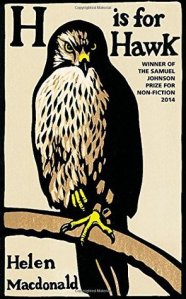
H is for Hawk

On Narrative Flow

For my first official post on Reading Like a Writer, I want to talk about Helen Macdonald’s memoir, H is for Hawk.

I almost called this post “In Praise of Narrative Flow” because that’s what initially pulled me into H is for Hawk – Helen Macdonald’s crazy-natural use of narrative flow.

But before I get into that, I should say up front that I kind of loved everything about this book. In a very personal way, it was exactly the right read at exactly the right time, so I can honestly say without any reservation that it’ll probably be one of my favorite books of 2016.

Now, to get back to narrative flow. What I mean by narrative flow is how the writer’s use of pacing, rhythm and execution, and how they interact with the reader. Here’s an example from Hemingway’s “Hills Like White Elephants”:

The woman brought two glasses of beer and two felt pads. She put the felt pads and the beer glasses on the table and looked at the man and the girl. The girl was looking off at the line of hills. They were white in the sun and the country was brown and dry.

Side Note: If you haven’t read Hemingway, goddamn, check out his short stories. I’m not a huge fan of his novels, but his short stories are a-maze-ing. He really was a master of the form.

So, narrative flow. This quote captures the tone of the story – staccato, disjointed and ambiguous. Things are said in this story through what is not said – the way the woman looks at the girl, the way the girl is looking off, the way the hills seem separate from the land. The flow is a little choppy, a little disorienting and that’s perfect because it mirrors the heat of the day and the girl’s state of mind. In this case, the narrative flow feeds into the story’s overall tone. It’s brilliant.

Helen Macdonald does something equally brilliant in H is for Hawk. Narrative flow is important regardless of what kind of narrative it is – fiction or nonfiction, short or long. Whereas Hemingway used flow to give his short story a visceral impact, Macdonald uses it to a different effect – she weaves a tapestry with it so the reader becomes wrapped in her grieving state of mind. And yet, the hawk remains firm and clear in the middle of her grief. The hawk is always the focal point.

The hawk had filled the house with wildness as a bowl of lilies fills a house with scent.

Macdonald’s imagery is threaded through her prose. It’s sensory and very specific. It also accurately reflects how thoroughly the hawk will come to define her life for a time. There are a million gorgeous quotes I could pull from this book, but they all have this quality – the prose is packed with more than words. Expand that out to the entire book and you get narrative flow.

There are two main threads in H is for Hawk and I’ll admit that, at first, I didn’t quite buy into one of them. In addition to her own autobiography of grief, Macdonald weaves in a mini-biography of T.H. White, the author of The Once and Future King, as well as, (more importantly for this book), The Goshawk, an account of his failed attempt to train a hawk. In the beginning, the White chapters felt a bit strange and intrusive. But slowly, they began to make sense. Slowly, they begin to reflect Macdonald’s fears and isolation as she trains her own goshawk, Mabel. The White chapters become critical to understanding the depth of Macdonald’s grief and how falconry becomes a metaphor for the process of healing.

They also act as a counterpoint to her relationship to her own hawk. White botched his hawk’s training horribly. Macdonald, by comparison, is hyper-aware of the bird, to the point that she begins to over-identify. As she does, the flow becomes leaner, tighter, and narrower, almost reflecting the pinpointed focus of the bird she’s training. Then, as the training progresses and she processes her grief, the focus slowly expands. The flow loosens. Macdonald’s narrative develops a rhythm that underscores her emotional experience. That alone helped me, as the reader, to connect to the book on a basic, instinctive level – it bypassed my brain and hit my emotions, which for me is where it counts.

And that’s the power of narrative flow – it’s a way to by-pass the reader’s logic and burrow under their skin. I’m sure there are other names for it, but that’s essentially how I think of the structural rhythm of a book. Some writers engineer it ahead of time, but that almost never works for me. When I write, the flow kind of just happens in the first draft. Then I hone it through revision and edits. Macdonald’s narrative rhythm feels so natural, so deeply tied to the text, that I wonder how much of it was engineered and how much of it just happened. If I’m ever lucky enough to talk to her someday, I would love to ask.

Reading Like a Writer

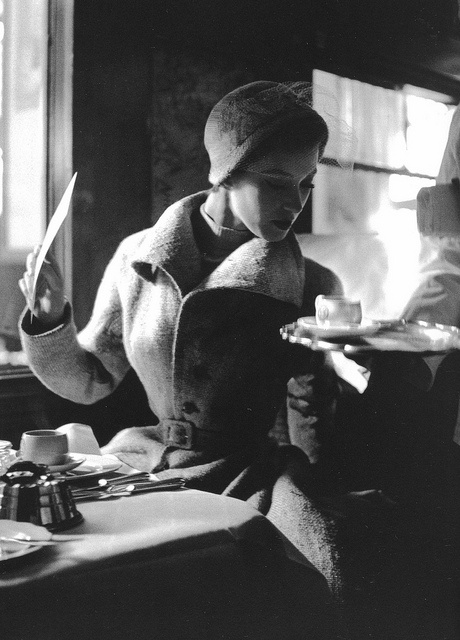
Black and white photograph of a woman looking out from a clock tower for Reading Like a Writer post by Malin JamesI’ve been thinking about how I want to approach writing about books. I used to write fairly standard reviews and that was fine but, honestly, there are so many good review blogs at this point that adding my opinion doesn’t feel particularly necessary. I can talk about what I liked or didn’t like about a book, but it doesn’t bring anything new to the table. And who knows, maybe there is nothing new to bring, but I want to try.
The fact of the matter is that my opinions aren’t unique – they’re personal and informed by my experiences – but so are everyone else’s. Generally speaking, my opinion doesn’t carry much weight for a person who isn’t me. That’s why I’m going to avoid the temptation of giving a general opinion and focus on something specific instead, something informed by the way I read.

The way I read has changed a great deal over the years. I used to read purely for entertainment. Then catharsis. Then curiosity. Then entertainment again. At this point, I read all across the board for a lot of reasons and, while I’m attracted to a different kind of book than I used to be (more on that in a post of its own) the fact is that I read widely from all sorts of genres and styles for all kinds of reasons. The only through-line in my reading is that I have an agenda. In addition to reading because I love to read, I read to become a better writer.

Even when a story has completely gobbled me up, part of my brain is whirring away, deconstructing and noticing and trying to figure things out. I love the craft of writing. I love technical elegance and subtle, inventive structures. I love the little mechanisms that make, or fail to make, a piece work. Sort of like a person who disassembles clocks, I love to dissect stories to see how they tick.

I’ve always done this to some degree, but the habit got formalized in college and grad school when I started applying theory to what I read. Later, when I started teaching myself how to write fiction, I applied the same principle. I found writing books that emphasized reading for different aspects of craft, from characterization and structure to pacing and voice. Slowly, I habituated myself to noticing these thing regardless of what I’m reading. That was more than twelve years ago, and that anatomical approach is just how I read now.

That’s why I talked about the structure Sarah Waters used in Night Watch and noticed the different way Muriel Spark manipulates the reader in The Driver’s Seat. It’s why I love Helen Macdonald’s use of a loose narrative style in H is for Hawk (there’s a post coming up on that). It’s not about me being all Miss Fancy Pants – it’s just the way I enjoy books.

So, rather than blog my general opinion, as scintillating as it may be, I’m going to write about the book from a writer’s perspective, hopefully in a way that isn’t totally boring for non-writers too. If nothing else, it’ll give me a chance to talk about two of the things I love most – stories and how they’re made.

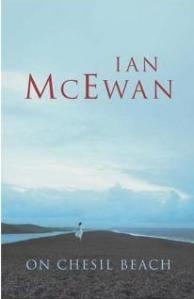
On Chesil Beach by Ian McEwan

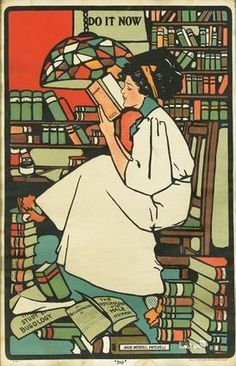
Woman in a library art nouveau for On Confronting Literature by Malin James

Dig by Sadie Wendall (1909)

On Books that Quietly Confront

I’ve had On Chesil Beach since it released in 2007. It’s a lovely little hardback and I picked it up without even looking at what it’s about because I love Ian McEwan. I remember taking it home and doing the rare thing of sitting down to start it right away (I usually buy books and put them in the long, long, long line of my TBR). But I got two pages in and stopped. I felt vaguely ill and I stopped. I slowly closed the book, set it on the shelf with my other McEwans and moved on without trying to think too much.

In the years since then, On Chesil Beach has sat on my shelf, biding its time. I say “biding its time” because it felt like an active presence in its own quiet way. I’d pull other books off the shelf to read, or to cull or consider, and think – I know you’re there. I’m going to read you, but I’m not ready yet. 

I couldn’t pick the book up, but I still mentally addressed because, in an odd way, it didn’t feel like an object. It felt like an experience I was going to have to have, one that was waiting patiently for me. It’s the most gently confrontational book I’ve ever read because the confrontation was very specific. Two pages in, it was clear that the experience of reading On Chesil Beach was going to be deeply personal. So I set it aside until I could process why. Here’s why:

I recognized too much of myself in those first pages. The situation in that narrow book resonated in a way that drew a personal line for me between literature that confronts by design (think Tampa or American Psycho) and literature that resonates to the point of confrontation. For me, On Chesil Beach is the latter, and it’s a very different thing than the former.

Literature that confronts by design is meant to challenge – you know what you’re getting into before you even start. Whether the challenge is emotional, psychological, moral or social depends on the book, but regardless of how it challenges, its intention (at least in part) is to challenge. I love a great many books that do this – The Driver’s Seat by Muriel Spark; The Cement Garden by Ian McEwan; Tampa by Alyssa Nutting and loads of others – some that I’ve actively enjoyed and others that were difficult but which I appreciate nonetheless.

That appreciation comes from the distance the intended effect allows me to have. If I pick up A Little LifeI’m going to brace myself for the experience of reading it. Same with An Untamed State. That doesn’t mean I won’t be emotionally affected – far from it. What it does mean is that the effect will very likely be tempered, somewhat, by two things – the fact that I was expecting it and the fact that others have been similarly affected by the book.

Cover of On Chesil Beach by Ian McEwan for On Confronting Literature by Malin JamesLiterature that resonates to the point of confrontation is different. For books like this, the confronting element is purely accidental and often deeply personal. On Chesil Beach is a perfect example. Nothing about it is directly confrontational – it’s about a young couple and their disastrous wedding night. No one gets killed, maimed, or traumatized. However, when you scratch the surface, it’s about a young woman’s complicated relationship with sex in the wake of sexual abuse, and the damage it does to her relationship. While it isn’t about trauma, it’s about the effect of trauma and that resonated with me in a deeply personal and challenging way.

Though the situation in the book is very different (and quite a lot simpler) than mine, it reverberated enough to feel dangerous when I first bought it. I’d suppressed a great deal and was, at the time, unprepared to examine large chunks of my childhood, my sexuality, my personality and my sexual / romantic relationships. This subtle, gentle book hit close enough to home that I knew within two pages that it was going to make me confront things I wasn’t prepared to acknowledge, so I set it aside and let it wait for me.

The fact that I was drawn to reading it now signals an important shift. I avoided it for years with the conscious understanding that I would “read it when I’m ready”. That I pulled it down from the shelf last week and read it in two days means that my relationship to those things I was trying to protect – memories of my childhood, my sexuality and my perceptions (of both myself and my relationships) – are strong enough now to bear the acknowledgement reading the book would mean.

Literature intended to confront is an important part of how you might understand experiences beyond your own. It’s a way to engage empathy and understanding and broaden your mind. Literature that resonates to the point of confrontation has the opposite effect. Rather than looking outward, it’s a passage inward to your personal experiences, one that can deepen your understanding of how you move through life.

Sometimes that’s a joyful thing. Sometimes that’s incredibly difficult. Either way, there’s great value in the challenge – so much so, in fact, that there’s nothing wrong with waiting until you’re able to process that value in a healthy productive way. It’s the difference between engaging your history and triggering yourself. When in doubt, opt for the approach that allows you to engage without hurting yourself.

The Night Watch by Sarah Waters

night_watch_318x500
On Structure and Chronology

There aren’t many writers I trust completely, but Sarah Waters is one of them. Regardless of where she takes me, I know she’ll get me there and back safely, whether it’s a Victorian insane asylum or an ambiguously creepy manor house post-WWI. In fact, her writing is pretty much guaranteed to do three things for me:

1. Emotionally affect me, often in very uncomfortable ways.

2. Challenge my expectations.

3. Teach me how to be a better writer.

Her fourth novel, The Night Watch, which has been sitting on my shelf since 2006, (I was saving it for a rainy day), does all three things so well that it may replace Affinity as my favorite of her books.

What surprised me most about The Night Watch was the structure. I know that doesn’t sound super exciting, but everything about it, from plot to characters, feels heightened because of it.

Rather than adhering to a standard, chronological structure, the narrative unfolds in reverse, starting in 1947 and moving backward through to 1941. The effect is amazing – events that would have struck me as suspenseful became massively poignant because of structural hindsight. The reader knows what’s coming, but the characters don’t, and yet, Waters balances that readerly omniscience with a lot of unknowns. She opens the novel with a clear picture of the characters’ fates, but you don’t understand the significance of those fates until the very end (or rather, beginning) in 1941. The tension that created anchored me to the book so hard I couldn’t put it down. (That’s where #3 – Teach me how to be a better writer – came in).

The Night Watch is comprised of the seemingly separate stories of three women and one man, but they are, in reality, tightly interwoven, a fact that Waters reveals slowly as their histories unfold. I don’t want to get too deep into how their stories interweave because spoilers would really ruin it, so instead I’ll talk about the characters who touched me most…which is to say, all of them – even the ones who were awfully flawed.

It’s the trick that Sarah Waters always manages to pull – that of putting difficult things in front of you while compelling you to read on. And I was compelled, just as I always am. The characters in The Night Watch ache with love, jealousy, desperation, fear, shame and the longing for things they can’t have. But while there is a lovely sense of hope for some of them, the future, for others, is left opaque, most affectingly, for me, the ambulance driver, Kay.

Kay may win or Kay may lose, but to see her win, Waters would have to allow us to see past the chronology of the book. The fact that we can’t might drive some people nuts, but it made me love the book even more. It underscores the fact that Waters is only giving us a sliver of their lives, which made their difficulties bear even more weight while casting the good in an even more poignant light.

I’m a glutton for that kind of thing, which is why I’m a fan of Sarah Waters. Though it took me ten years to read The Night Watch, I’m glad I waited for that rainy day. As a reader, I brought much more to the table at 38 than I would’ve at 28. That said, I’m going to try not to make it another ten years before I read The Paying Guests.


On Style in Prose

Letter & CoffeeI’ve been writing for about 11 years now, and I can honestly say that it’s only been in the past 2 that I’ve begun to find my style… Or rather, styles, because I have several – it just depends on what I’m writing.

For the first 8 years of that 11, I was terrifically preoccupied with finding “my style”. What I didn’t realize at the time was that you have to be able to write first. Hemingway didn’t start off sounding like Hemingway. You can see hints of  Papa’s style in his early novels, but his authorial voice was still in the developmental stages until it peaked with “The Killers” and “Hills Like White Elephants.” Unfortunately, Hemingway also demonstrates the danger of being too wedded to any one style – later in his career, he fell off the ledge into self-parody… Please don’t hate me fans of Hemingway.

What I failed to realize as a young writer is that, in much the same way that a teenager is a human work in progress, a new writer isn’t fully formed until she gets some experience, (i.e.: shitty stories and lots of rejection), under her belt. The idea that I would have to live through tons of rejection, and that every story I wrote for years would be nothing more than a learning experience terrified and daunted me 11 years ago. Luckily, I’m incredibly stubborn…and I really love to write. So I plowed ahead through all that shittiness until my writer-self began to grow up.

It was a long and painful process – not just for me, but for the people who valiantly read 10th, 20th and 25th revisions, (I’m not kidding), of a stories that were never going to work – not because I’d used the work “enamored” twice on one page, but because the damn things just didn’t have a plot. It took awhile to figure that out, (sorry valiant people), but as soon as I did, things started to fall into place.

And that’s when I realized that a writer’s style is really just a reflection of the writer’s personality. Very often it’s surprisingly subtle. Word choice is part of it, sure, but even more than that, it’s the quirks and humor and punch and flow that form your sentences. It’s the way you turn a phrase. It’s the “sound” of your writing, the rhythmic rise and fall in your tension and pacing – that’s not something you can force, nor is it something you can develop on purpose. It just has to come. In other words, don’t ask the caterpillar how it walks – it’ll trip all over itself. Just let the little guy do his thing.

When it comes down to it, style is just one more lens through which to read a writer’s work. And yes, it is important. That said, it’s also something that works itself out. You don’t need to worry about finding it – if you give it enough time, it will find you.

Books, or My Fetish

A two story gallery of books in the old library at Trinity College Dublin for Books, My Fetish by Malin James

Old Library, Trinity College, Dublin

So, let’s play a game. When I say fetish, you say…

SEX!!!

Probably. Or possible not, but for the sake of argument, let’s assume you say, SEX!! Most people, including myself, do. After all, in Western popular culture, fetish really does = sex.

And why not? There are plenty of fabulous sexual fetishes out there – feet, hands, pain, exhibitionism, voyeurism.. hell, there’s even an eyeball-licking fetish.

But not all fetishes are strictly sexual. In fact, traditionally speaking, (and by traditional I mean dating back to the early 17th century), fetishes were spiritual in nature, and were almost always objects worshipped for their supposed magical powers. If you go by the original meaning, anything from a voodoo doll to a saint’s relic is a fetish – an object used or revered for it’s spiritual power.

This made me realize something. I have a book fetish – a serious, committed, barely-restrained book fetish.

It isn’t that I literally worship books because I think they’re literally magical. It’s more that, for me, books have an inherent value and, because of that, they are the locus of my compulsion to acquire new things. In other words, some people have shoes, other people have exes, and I have books.

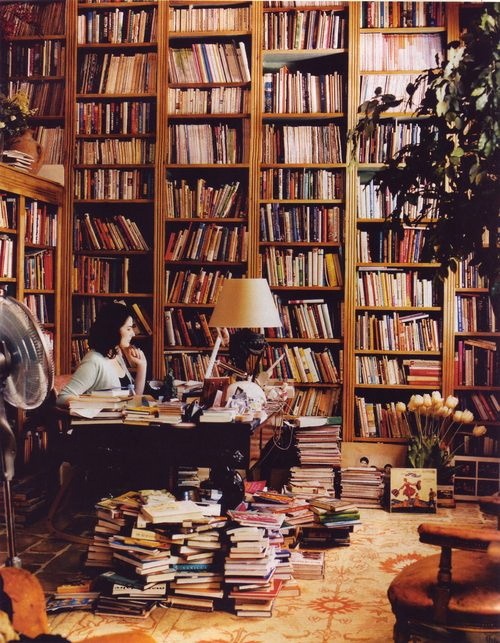
Nigella Lawson's private library. Image courtesy bookmania.me

Nigella Lawson’s private library. Image courtesy bookmania.me

Since I was old enough to buy my first Nancy Drew with my very own money, I have surrounded myself with books. I buy, borrow, give, and receive books with a pure, transactional joy that should be acquisitive but isn’t. Really, I just love books. I love stacking them, collecting them, rearranging and classifying them. I love holding them and writing in their margins, and of course, I love reading them.  The book, as an object, is comforting to me. It doesn’t matter if I’ve read it five times or never heard of it, books are totems. They are, quite literally, a mental escape hatch, and in that way they are an incredibly significant part of my personal growth.

I can trace my development as a person back through my reading material, from Laura Ingall Wilder’s Little House books to A.S. Byatt, Dorothy Parker and Anais Nin. Each phase in my reading reflects an emotional phase in my life, and the books that I read during those phases are, in essence, relics of the person I was. My books are a map of my past, and an indicator of future interests and selves. So yes, I have a old-fashioned fetish. I attach spiritual significance to books. I will never read every book I own, and I will never own enough… That doesn’t mean I’m not going to try.


Defining Literature

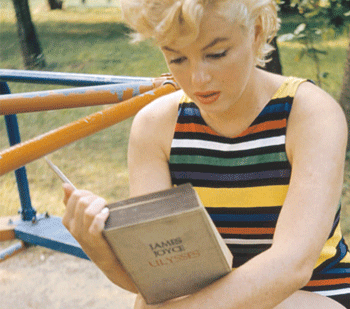
Marilyn Monroe reading Ulysses. Cover image for James Joyce: A Critical Guide, image for Defining Literature post by Malin James

Marilyn Monroe reading Ulysses. Cover image for James Joyce: A Critical Guide

Tuesday was April 1st, which means that no one on the internet could be trusted, including Sparky Sweets, PhD., one of the awesome minds behind Thug Notes, a weekly series on YouTube in which Dr. Sweets systematically breaks down the Western Canon, 4 minutes at a time, in a gangsta version of Cliff’s Notes.

At some point, I’m going to do a post on why I love Thug Notes, because the show is doing something incredibly important, but for today I’m going to focus on Tuesday’s installment – Summary and Analysis for Stephanie Meyers’ Twilight… APRIL FOOL’S! It was actually Huck Finn masquerading as Twilight. I laughed my ass off – they got me 🙂

Anyway, a friend posted the link to my Facebook wall and there followed a short thread in which people enjoyed the joke. One commenter also mentioned that it’s important to get kids to read “real literature”, (I’m paraphrasing). The thread ended when another commenter posted that she had greatly enjoyed the Twilight series, and felt that the definition of “literature” is “in the eye of the reader.” This, of course, got me to thinking..

This small disagreement points to a larger scale dispute in Western publishing, education and culture. Why do people read? Are certain books more valuable than others? How, in fact, should we define “literature”?

While I don’t think that the definition of literature is in the eye of the beholder, I do think that the value of a book is. The commenter who had enjoyed Twilight did something that is perfectly reasonable – she enjoyed Twilight. That series was not designed with any greater purpose than to be enjoyed. As a result, it’s value lies in how well the reader enjoys it. This reader enjoyed it a great deal, so Twilight is legitimately valuable to her – just as valuable as Anna Karenina or Huck Finn is to someone else.

The value placed on a book is personal, and it has to do with two things – the reader and the book’s intended purpose. The Firm, Cuckoo’s Calling and the entire Danielle Steel catalog were written to be enjoyed and consumed, and there is great value in that. Vehicles for escapism are, actually, valuable. It does not, however, make them literature, and here’s why:

Literature is a specific kind of fiction. Literature can, and often does, entertain, but it has a twin purpose –  to examine something in some way. This examination can be anything from the American dream (The Great Gatsby) to the nature of sexual submission, (The Story of O). Literature doesn’t want you to escape, it wants you to engage, and therein lies the difference.

The problem comes when people assign judgements to these two different purposes by devaluing a fun read, like Twilight, while falsely elevating “literature”, like Ulysses. In fact, what I like about Thug Notes is that it topples the ivory tower that literature is placed on so often – literature can, and should, be enjoyed. It just also asks you to think, or analyze, or ponder, or consider.

If you’d prefer to get lost in a story and escape, read an awesome book – that’s great. If you prefer cultural commentary with your enjoyment, read literature. Better yet, read both. Enjoy both. And find the value in both. Really, when it comes down to it, just read. That’s the most important thing.