Small Fiction: The Couch

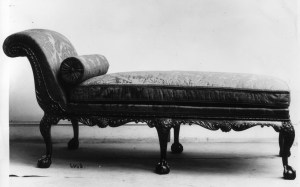
Black and white historical photograph of a 19th century chaise lounge for Flash Fiction: Grounded by Malin James

19th c. chaise lounge

She sits on the  dubious comfort of a well-intentioned couch. It had once been roly-poly, but its horsehair stuffing had been flattened by time and use. Now, it was a child’s drawing of the thing it’s supposed to be.

Equally dubious, she sits on the aspirational couch and allows Dr. Salt to prod at her equally flattened softness. Resentfully, she feels her stuffing begin to ooze. She sets her jaw and jams it back in. She does not like Dr. Salt, but she had promised Henry. Sadness has made her difficult to live with.

Dr. Salt’s techniques are reasonable, but they strike her as somewhat sinister. He calls them “grounding”, as if she were lightening that must be bottled.

How does the couch feel, Dr. Salt drones. Tell me, how does it feel?

Dr. Salt, she thinks, looks determined.

“Dead”, she replies. She is determined too, and it shows on her face, which is cool, and smooth, hard. Very unlike the couch.

Dr. Salt’s brow furrows with clinical concern. She frowns and sees that she’d better explain.

“The couch is an object, Dr. Salt. In terms of feeling, it’s a dead thing. It has no nerves, no skin. There is nothing to hurt. Or is that not what you meant?”

Dr. Salt is quiet.

She plucks at a loose thread in the brocade, certain that she is not causing pain.

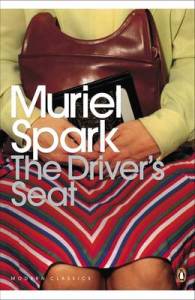
The Driver’s Seat by Muriel Spark

Cover image of The Driver's Seat by Muriel Spark for Mean Fiction by Malin James

On Mean Fiction

It took me all of an hour to read Muriel Spark’s novella, The Driver’s Seat. It’s lean and  incredibly mean in the way children can be. There’s something viciously natural in the way adolescent social politics play out, with mutable hierarchies determining social life and death.

That same, subtle viciousness underlies The Driver’s Seat, not in any textually obvious way, but in how it engages the reader’s sympathies, as well as that adolescent sense of assumption and judgment. I’ll be honest – it’s not a comfortable read, but it’s also why I loved the book. That subtle, dark, destabilizing meanness is what makes the story so very wrong, and so very good.

I don’t like doing plot summaries, but in this case, I think a brief one is important. The Driver’s Seat is about a woman named Lise who goes on holiday, ostensibly looking for her “boyfriend”. Lise’s goal for the trip deceptively simple and she executes everything with mad sort of meticulousness. It isn’t until towards the end that the reader fully grasps what her goal actually is.

What makes this book brilliant, is that the entire book hinges not so much on what happens, but on why and how it happens. In fact, Spark reveals Lise’s fate within the first few pages, but it doesn’t actually matter. The narrator drip feeds the reader a string of seemingly random oddities in Lise’s behavior, and she does it so effectively that you almost feel safe in what you’ve been told is going to happen. In fact, there were times when it felt like the narrator wants the reader to pass notes behind Lise’s back. After all, it’s obvious that Lise is unhinged but…not in the way Spark wants you to expect.

So, how does Spark play with the reader? She does it through Lise and how we’re meant to engage her. Lise’s oddness compounds itself in unsettling and somewhat ridiculous ways, from her hysteria at being told that a dress is stain resistant, to her single-minded search for her “boyfriend”. Spark plays on the reader’s empathy (or lack of empathy) in a very personal way, tapping into those early adolescent social experiences and memories – the ones that might prompt the reader to either feel sorry for Lise or laugh at her (or possibly both).

Everything in the way Lise interacts with people is not quite right. She’s a very deliberate portrait of what happens when a normal woman becomes unhinged, and the reader becomes complicit in that portrait. Our reactions to her are, in many ways, the reactions Lise has most likely experienced for a great deal of her life. We become part of the world she navigates, if only for the sliver of her life that we witness.

As a character, Lise feels dangerous and unpredictable, but only because she subverts our expectations of what a lonely spinster should be. Spark gives her a dismissable, almost laughable veneer and then slices it away to reveal an almost terrifying degree of personal agency in Lise. It’s that determined, single-minded agency that is, in fact, the novel’s central threat.

That trick of drawing the reader in and then destroying their expectations it what gives The Driver’s Seat it’s deep, satirical bite. It’s also what makes it such a marmite book – people either love it for its meanness, or they hate it. Becuase it isn’t a comfortable read – I knew that going into it (thanks to this awesome discussion) but I was still shocked at thoroughly I was manipulated, even as I admired Spark’s subtlety in pulling it off.

The triumph of all of the darkness and bite is that the reader becomes complicit in Lise’s fate, and her fate is not nearly as simple or straightforward as Spark implies at the start. It’s what makes this novel an experience as much as it is a story. In the end, it’s a tremendous portrait of a woman’s desperate, single-minded pursuit of autonomy, but whether or not she’s successful is left unclear. I may need to read it again to sort that out.

51FB7KX99ML._SX303_BO1,204,203,200_Side Note: 4/12/16

I just finished Aiding & Abetting, also by Spark, and it’s another example of author manipulation and reader complicity, though in a totally different (completely hilarious) way. Ultimately, in both novels, as different as they are, it’s Spark’s brutal lack of sentimentality that makes the dark, serrated edges work. She has razors in her fingers and I love it.

She once wrote that she “aims to startle as well as please” and, for my money, so manages both like a boss.

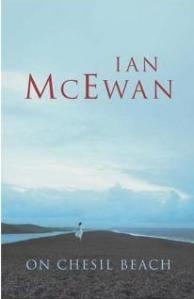
On Chesil Beach by Ian McEwan

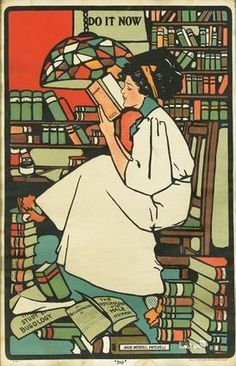
Woman in a library art nouveau for On Confronting Literature by Malin James

Dig by Sadie Wendall (1909)

On Books that Quietly Confront

I’ve had On Chesil Beach since it released in 2007. It’s a lovely little hardback and I picked it up without even looking at what it’s about because I love Ian McEwan. I remember taking it home and doing the rare thing of sitting down to start it right away (I usually buy books and put them in the long, long, long line of my TBR). But I got two pages in and stopped. I felt vaguely ill and I stopped. I slowly closed the book, set it on the shelf with my other McEwans and moved on without trying to think too much.

In the years since then, On Chesil Beach has sat on my shelf, biding its time. I say “biding its time” because it felt like an active presence in its own quiet way. I’d pull other books off the shelf to read, or to cull or consider, and think – I know you’re there. I’m going to read you, but I’m not ready yet. 

I couldn’t pick the book up, but I still mentally addressed because, in an odd way, it didn’t feel like an object. It felt like an experience I was going to have to have, one that was waiting patiently for me. It’s the most gently confrontational book I’ve ever read because the confrontation was very specific. Two pages in, it was clear that the experience of reading On Chesil Beach was going to be deeply personal. So I set it aside until I could process why. Here’s why:

I recognized too much of myself in those first pages. The situation in that narrow book resonated in a way that drew a personal line for me between literature that confronts by design (think Tampa or American Psycho) and literature that resonates to the point of confrontation. For me, On Chesil Beach is the latter, and it’s a very different thing than the former.

Literature that confronts by design is meant to challenge – you know what you’re getting into before you even start. Whether the challenge is emotional, psychological, moral or social depends on the book, but regardless of how it challenges, its intention (at least in part) is to challenge. I love a great many books that do this – The Driver’s Seat by Muriel Spark; The Cement Garden by Ian McEwan; Tampa by Alyssa Nutting and loads of others – some that I’ve actively enjoyed and others that were difficult but which I appreciate nonetheless.

That appreciation comes from the distance the intended effect allows me to have. If I pick up A Little LifeI’m going to brace myself for the experience of reading it. Same with An Untamed State. That doesn’t mean I won’t be emotionally affected – far from it. What it does mean is that the effect will very likely be tempered, somewhat, by two things – the fact that I was expecting it and the fact that others have been similarly affected by the book.

Cover of On Chesil Beach by Ian McEwan for On Confronting Literature by Malin JamesLiterature that resonates to the point of confrontation is different. For books like this, the confronting element is purely accidental and often deeply personal. On Chesil Beach is a perfect example. Nothing about it is directly confrontational – it’s about a young couple and their disastrous wedding night. No one gets killed, maimed, or traumatized. However, when you scratch the surface, it’s about a young woman’s complicated relationship with sex in the wake of sexual abuse, and the damage it does to her relationship. While it isn’t about trauma, it’s about the effect of trauma and that resonated with me in a deeply personal and challenging way.

Though the situation in the book is very different (and quite a lot simpler) than mine, it reverberated enough to feel dangerous when I first bought it. I’d suppressed a great deal and was, at the time, unprepared to examine large chunks of my childhood, my sexuality, my personality and my sexual / romantic relationships. This subtle, gentle book hit close enough to home that I knew within two pages that it was going to make me confront things I wasn’t prepared to acknowledge, so I set it aside and let it wait for me.

The fact that I was drawn to reading it now signals an important shift. I avoided it for years with the conscious understanding that I would “read it when I’m ready”. That I pulled it down from the shelf last week and read it in two days means that my relationship to those things I was trying to protect – memories of my childhood, my sexuality and my perceptions (of both myself and my relationships) – are strong enough now to bear the acknowledgement reading the book would mean.

Literature intended to confront is an important part of how you might understand experiences beyond your own. It’s a way to engage empathy and understanding and broaden your mind. Literature that resonates to the point of confrontation has the opposite effect. Rather than looking outward, it’s a passage inward to your personal experiences, one that can deepen your understanding of how you move through life.

Sometimes that’s a joyful thing. Sometimes that’s incredibly difficult. Either way, there’s great value in the challenge – so much so, in fact, that there’s nothing wrong with waiting until you’re able to process that value in a healthy productive way. It’s the difference between engaging your history and triggering yourself. When in doubt, opt for the approach that allows you to engage without hurting yourself.

The Night Watch by Sarah Waters

night_watch_318x500
On Structure and Chronology

There aren’t many writers I trust completely, but Sarah Waters is one of them. Regardless of where she takes me, I know she’ll get me there and back safely, whether it’s a Victorian insane asylum or an ambiguously creepy manor house post-WWI. In fact, her writing is pretty much guaranteed to do three things for me:

1. Emotionally affect me, often in very uncomfortable ways.

2. Challenge my expectations.

3. Teach me how to be a better writer.

Her fourth novel, The Night Watch, which has been sitting on my shelf since 2006, (I was saving it for a rainy day), does all three things so well that it may replace Affinity as my favorite of her books.

What surprised me most about The Night Watch was the structure. I know that doesn’t sound super exciting, but everything about it, from plot to characters, feels heightened because of it.

Rather than adhering to a standard, chronological structure, the narrative unfolds in reverse, starting in 1947 and moving backward through to 1941. The effect is amazing – events that would have struck me as suspenseful became massively poignant because of structural hindsight. The reader knows what’s coming, but the characters don’t, and yet, Waters balances that readerly omniscience with a lot of unknowns. She opens the novel with a clear picture of the characters’ fates, but you don’t understand the significance of those fates until the very end (or rather, beginning) in 1941. The tension that created anchored me to the book so hard I couldn’t put it down. (That’s where #3 – Teach me how to be a better writer – came in).

The Night Watch is comprised of the seemingly separate stories of three women and one man, but they are, in reality, tightly interwoven, a fact that Waters reveals slowly as their histories unfold. I don’t want to get too deep into how their stories interweave because spoilers would really ruin it, so instead I’ll talk about the characters who touched me most…which is to say, all of them – even the ones who were awfully flawed.

It’s the trick that Sarah Waters always manages to pull – that of putting difficult things in front of you while compelling you to read on. And I was compelled, just as I always am. The characters in The Night Watch ache with love, jealousy, desperation, fear, shame and the longing for things they can’t have. But while there is a lovely sense of hope for some of them, the future, for others, is left opaque, most affectingly, for me, the ambulance driver, Kay.

Kay may win or Kay may lose, but to see her win, Waters would have to allow us to see past the chronology of the book. The fact that we can’t might drive some people nuts, but it made me love the book even more. It underscores the fact that Waters is only giving us a sliver of their lives, which made their difficulties bear even more weight while casting the good in an even more poignant light.

I’m a glutton for that kind of thing, which is why I’m a fan of Sarah Waters. Though it took me ten years to read The Night Watch, I’m glad I waited for that rainy day. As a reader, I brought much more to the table at 38 than I would’ve at 28. That said, I’m going to try not to make it another ten years before I read The Paying Guests.


Review: Shadow of the Wind

Shadow of the WindThe Shadow of the Wind by Carlos Ruiz Zafon

The Shadow of the Wind by Carlos Ruiz Zafon is not a new book. It came out in 2001 and became an international best-seller, which is probably why, whenever I ecstatically mentioned it, someone said something like, oh, yeah – I read that 15 years ago and I loved it. So, yes. I’m late, but I got there.

This was one of those alchemical, magical reading experiences that reminds me of why I love books as much as I do. In fact, it’s the first time in ages that I’ve gotten “book tingle” . So, here’s what worked for me.

The plot is as tight as it is labyrinthian; the setting – Barcelona during Franco’s regime – is so effortlessly realized; the tone of elegant decay and creeping danger felt like cobwebs on the skin. Separate from objective “craft elements”;, there is a “Spanish-ness” that I found incredibly familiar and comforting, (my grandparents escaped Franco’s Spain). As I read, I  could practically smell the garlic simmering on the stove.

It’s rare to find a book that is not only fast-paced and plot-driven, but emotionally affecting. While the novel itself could best be described as a literary or historical thriller, Zafon spends as much energy on characterization as he does on pacing and plot. I connected with even the most tertiary characters, like a  nurse, unjustly warehoused in an old-age asylum, m because Zafon invited me to care.

This worked especially well with the book’s narrator / protagonist, a bookseller’s son named Daniel. The death of his mother endears you to him immediately, so that, when his father takes him to the gorgeously conceived Cemetary of Forgotten Books you want something special to happen. And it does.

The young Daniel chooses one book – The Shadow of the Wind by a brilliant but forgotten author named Julian Carax. Daniel’s quest to protect Carax’s legacy drives him deep into the past with a doggedness that eludes him in other areas of his life. There is an unspoken, latitudinal connection between Carax and Daniel that works quietly on how the reader engages the book. Their unfolding connection gives the novel much of its gothic pull.


Return of the Prodigal Writer Person

Color photograph of Malin James scowling happily in concentration for Return of the Prodigal Writer Person post

Happy Thinking Face

I set this blog aside more than 2 years ago when I decided to focus on other areas of writing. As much as I missed it, I’m glad I did because the time I spent honing in on erotica and sex writing resulted in a ton of growth, both as a person and as a writer. While my fiction is starting to skirt the edges of different genres, sex and sexuality have become the central thrust (ha!) of my creative and professional life. In fact, the past two years have helped me realize that sex is the lens through which I naturally see the world. But more about that on my other site.

Cleverboots is, and always has been, a kind of miscellany, as opposed to the dedicated focus of People. Sex. Culture. That dedicated focus is a really good thing, but it leaves some of my personal passions dangling, most especially reading. I slowly stopped reading for pleasure and only read for work (before you say “poor, baby”, figure it’s like a barista not wanting coffee at home).

Thanks to all of my work reading, gender identity, feminism, the body politic and other social concerns now flash a bright on my cultural radar. Unfortunately, a lot of my other areas of interests, like history, psychology, and non-erotic fiction, got uncomfortably dusty.

Now that things on the People. Sex. Culture. side of writing are established and slowly growing, I’m anxious to get back to basics. That’s largely reading for pleasure, but it also covers a lot of other things, like film, pop culture and current events. So, I’m rebooting Cleverboots as a personal / book blog.

So, that’s what I’m up to here. People. Sex. Culture. is still my primary site, just as the scope of my writing is naturally sex-related – nothing there is changing. More than anything, Cleverboots will function as an occasional, personal / reader’s blog. And  I can tell you right now that it’s going to be a pretty casual place.

I’m going to be pretty open with topics and write fairly off the cuff (except for reviews, which will be earnest and considered because I can’t helpt it). I’ll also end up posting the odd, occasional story that has nowhere to go. If my other site is a pair of pretty heels and a classy, black suit, Cleverboots is jeans and my favorite sweatshirt. Both are 100% me. This is just where I’m likely to rant, ramble and brood like the Super Big Book Nerd I am.

On Integrity

Woman looking into compact mirror. black and white image.

Vintage advertisement. Image courtesy favim.com

A few days ago, I was in the car listening to an interview with Tavis Smiley, an African-American social critic and all-around intellectual bad-ass. In recent years, he’s come under fire from the African-American community for holding Barack Obama publicly accountable for his failure to better address issues of poverty in America.

While knew that Smiley had become persona non grata in his own cultural community for voicing criticism of the first black President of the United States, it was only in the wake of the interview that I considered just how much intellectual integrity such a critique requires. This is a man less interested in cultural or political ideology than he is in truth. Now that is integrity. And integrity is rare.

They say that the quality you hate most in other people is the quality you hate in yourself. Conversely, I would say that the thing you admire most in others is that which you most long to have. For me, that most admired quality is integrity. Having integrity is hard. Integrity is, among other things, being willing to do the hard thing for no other reason than that it is right.

For most of my life, I had no integrity, (and no, I’m not being hard on myself). I never did the hard thing because hard things were hard – or stressful, or saddening, or difficult, or uncomfortable or, or, or…. I trafficked in excuses, both with others and myself. I was sick. I was swamped. I was stressed. I was something. Anything. Just give me an excuse, and if that excuse inspired sympathy, bonus points.

Excuses were easier than integrity. Much easier. Unfortunately, making excuses also meant that I was perpetuating a lie and creating my own mythology – a comfortable little narrative that kept me insulated from the reality of myself. And then my mythology fell apart.

Someone I know once said that if you and your self-image aren’t matching up, one of you has to change. In my case, I was nowhere near being the strong, confident, compassionate person I thought I was – a fact that became disturbingly clear after a series of painful realizations.


Image of Tavis Smiley

Image of Tavis Smiley, courtesy theatlantic.com. On a personal note, I love the look on Smiley’s face.


Once faced with an unavoidably clear picture of myself, I realized that I had three options.

1. I could accept my new, truthful self-image, disgusting warts and all.

2. I could try to delude myself back into my happy comfort zone, (no dice there, I’d already swallowed the red pill).

3. I had to change.

Now, let’s be clear. Living with the fact that I was a moody, self-absorbed stress puppy held zero appeal. I had to change, mostly because I was, (and am), too vain to settle for being less than someone I can respect.

Integrity is, for me, a hard-won import of a quality. Someone else I know is fond of saying that the danger with integrity is that you never know when you’ve lost it, and I believe this to be true. I fear the easy answer like almost nothing else. I fear my own ego and the trap of self-admiration. I fear ideologies because there is safety in belonging, even if you trade yourself in exchange. I fear spoon-fed logic because, for so long, I failed to think for myself.

Consequently, there is literally nothing more attractive to me than a person with integrity. They are what I strive to be – their own honest judge of themselves and their circumstances. That’s why I so respect Tavis Smiley, whose politics I both do and do not agree with. He is a person with towering integrity – both intellectual and personal – and that is that is the quality I most need to nurture in myself.

Fiction: Nighthawks

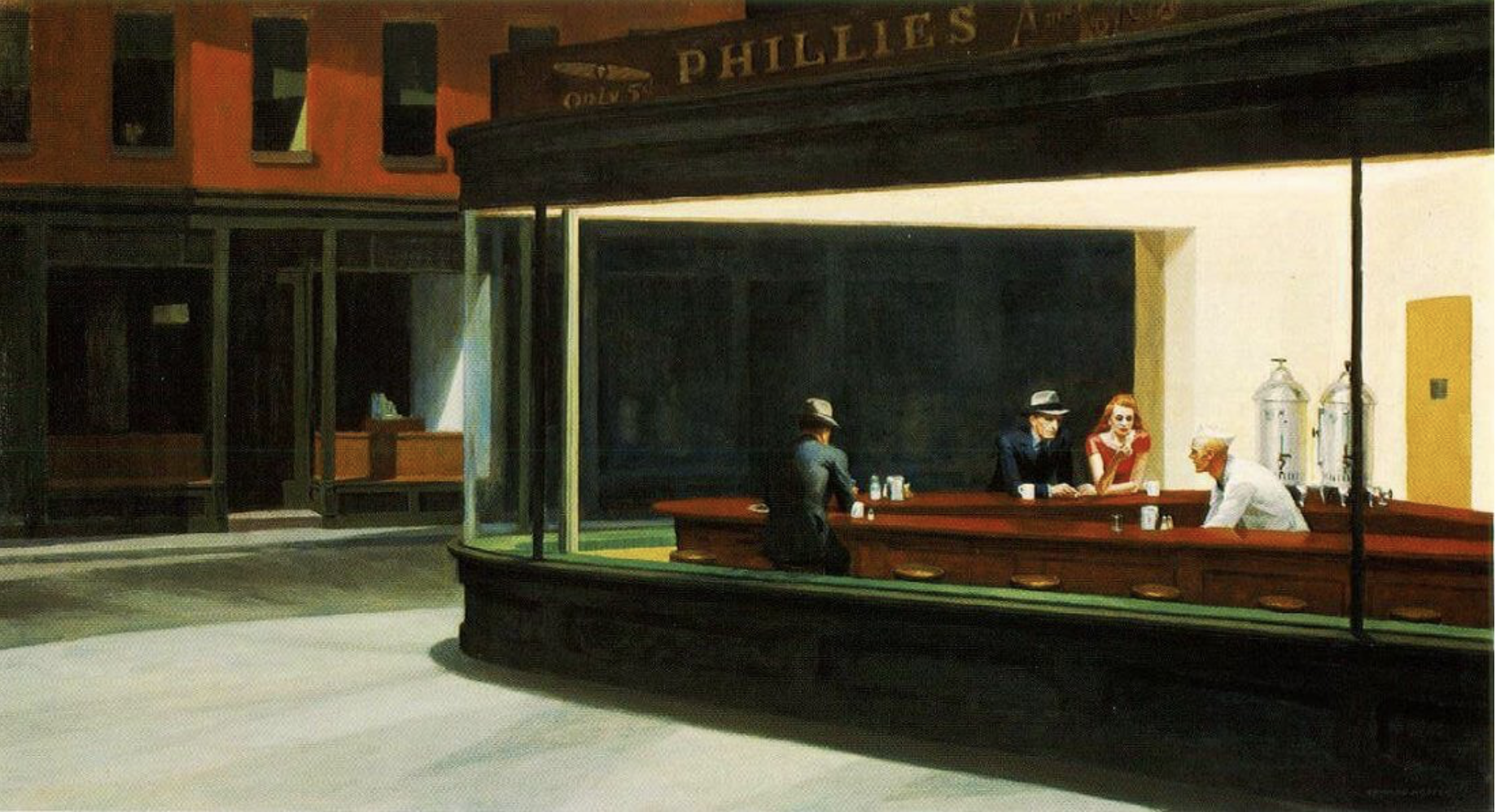
Nighthawks by Edward Hopper, 1942

Rose

Rose looked at her reflection in the polished mahogany counter. She didn’t look good. The day had caught up to her, stripped her color and sharpened her face. She dabbed at her lipstick with a napkin. Too red. It looked funny. Rose put the napkin down. She used to like that red. So had Eddie. Eddie had liked that color.

Red, red lips for my red, red, Rose….

Rose’s hand plucked at her earring, her coffee, her locket, before inching over to rest on Rob’s sleeve. She liked the feel of his woolen jacket under her quick, nervous fingers. Nice and warm. Solid. Rob. She sighed. It had been a long day. It was time to go. She wanted to say that. It’s been a long day. It’s time to go. But his downcast eyes trapped the words in her mouth. He wasn’t ready yet. She could wait.

Widowed at thirty. Thirty was too young for how she felt. For how she looked too. Her reflection looked worn out and old—not pretty anymore. Her eyes slid to the floor. She didn’t really care. Everyone was dead. Eddie was dead. The baby was dead. Her father—hers and Rob’s—was dead, but that was nothing to cry about. Their father had been a lucky son-of-a-bitch.

Rose glanced at her brother and stopped the thought, just in case he read her mind. Sometimes he could. He couldn’t, not really. But sometimes he knew. She couldn’t read his either, but sometimes…. She clutched her thick, glazed coffee mug with both hands, prepared to wait.

It’s been a long day. It’s time to go home.

She looked at Robbie’s profile, his hawkish face, and quietly looked away.

The dead weren’t lucky, but she felt like they were. She couldn’t say that to anyone, especially her baby brother. He didn’t need to hear it. He’d done enough already – more than she wanted him to. He’d visited her in the hospital and tied pink ribbons around her wrists. He came by or called every day. He worried so much. She made him worry.

You worry, Robbie. You worry too much.

She was tired. It was time to go home.

Rose sighed, a small, shallow breath. Everything was done. This time he’d have nothing to find. Poor Robbie.  She was glad they’d spent the whole day. Rose fingered her locket. The gold was warm. It felt soft when she pressed it. There was a picture of Eddie and the baby inside.

She glanced at her brother through her sweep of red hair. Red, red hair. Red, red Rose. Rob’s comfortable silence was the only thing she would miss. His face looked dark, like a shuttered house. No lights. Locked doors. She had to wait for him to be ready. They would sit together in this in-between place, coffee cold in their cups. When he was ready, he would take her home, and then she would go to Eddie and the baby. She loved her brother. She could wait.

Robert

Robert knew that she was going to try it again. He could read it like newsprint in the lines around her mouth. He missed her smile, her real smile, her cracking, half-cocked grin. He hadn’t seen it in months. Instead he got what she gave him now…pale lips under too much lipstick. Her hand was cold on his arm.

She’d gotten dressed up for their day out, special occasion dressed up—Hayworth hair, her favorite pink dress, she’d even worn perfume. But her bones were sharp beneath her collar. Her wrists were thin and hard. He wished she’d worn a sweater. It was turning cold, too cold for a thin, silk dress.

Why don’t you bring a sweater, Rosy?

I’ll be okay.

The second she’d said that, he’d known. That dress, her hair, her too bright face…he’d known exactly what was coming, and he didn’t want to know.

He lit a cigarette and let it burn. Tiny column of ash. Then he lit another. Beside him Rose shifted, patient, silent. She wanted to go home.

See you tomorrow, Rose

I love you, Rob.

Robert sipped his coffee. He should say something. He should stop her. But, Jesus, she looked spent up…. Rob glanced at his sister, though the sweep of her strawberry hair, but he couldn’t see her face. He wasn’t sure he wanted to. Robert signaled for the check. It was time to take her home.

“More coffee?”

Robert paused.

The waiter poured.

One more cup.

Charlie

Wish that kid would quit staring and do his job. Goddamn coffee’s cold.

Across the diner, the old man hunched over the counter like a bulldog over a bone. He eyed the yellow-haired waiter, who was eyeing the redheaded girl. Like staring was going help her. A gal like that never left her man, not if he beat her into the ground. After thirty years he knew.

Charlie rubbed his bum knee. He wished he could sleep. He hadn’t slept since he’d retired. Not a full eight hours. Not in a month. Best wishes, Charlie! Retirement—you lucky son-of-a-bitch!

Yeah. Real lucky.

Charlie leaned back on the hard stool, regretting the watch the boys at the precinct had given him. He hated fishing, hated crosswords. His buddies were still on the force. Doris was remarried and Katie was busy, making a life of her own. She’d even gotten a job—secretary at some firm. Smart girl. Katie had always been smart. Maybe not pretty, but smart. He could hear Doris telling her to dress up nice for work. Christ, he wished Doris would shut-up.

Charlie shot the waiter a look and clacked his cup softly. The kid strolled over, refilled it from the urn and handed it back to him. Up close, Charlie realized, the kid wasn’t much of a kid. Pushing thirty, he’d bet. Charlie grunted. At twenty-six, he’d already been on the force for five years. Guy should get a real job.

Charlie looked out the diner’s plate-glass window at the dark, disinterested street. What did you do when you got cut loose?  Kid’s got his whole life and he wastes it, like it’s something to toss away. The old man shifted. He was starting to hate that kid….

He should probably head home. It was a long walk back to his place. Maybe that would wear him out. He reached for his wallet, straining the seams of his suit. Cheap suit. Work suit. He took out his Luckies instead. One cigarette. One more cup. Then he’d toss a buck on the counter and take the long walk home. Back to his apartment. He hated that apartment. He hated the way it looked—half empty, full of nothing worth saying, like old newsprint. He hadn’t seen it that way before. He hadn’t had time—he’d barely ever been home. Now he saw every night. Charlie sucked the hot coffee between his teeth.

Christ, he wished he could sleep.

Joe

That lady looks sick. Joe glanced up from a tray of half-empty saltshakers. What’s she doing out so late with that guy, anyway? She looks like she should be in a hospital or something….

Joe shook his head and refilled the shakers without taking his eyes off the lady in the pink dress. He was good at working and watching. He never spilled.

Look at how she’s holding his arm, he thought. Like she’s gonna drown and he’s the only thing keeping her afloat.

That was good, Joe thought. He had to write that down. He stopped pouring and wiped his hands before getting out the little notebook he kept in his apron pocket.

He loved working the late shift. Nothing like it for writer’s block. Nothing like it for inspiration. The lady and her fella were great. He had to use them somewhere…maybe he’d put her in a sanitarium and make the guy her lover. And the guy… a private eye with a shady past? Maybe he broke her out and now they’re on the run. However Joe wrote it, it was gonna be tragic. That lady was tragic all over.

Joe glanced across the counter at the old guy sitting on his own. Not much there. Just a sad sack. He wasn’t as compelling but Joe could work with it. Maybe a tired crime boss or a has-been reporter. Joe studied the man nursing his hundredth cup of coffee. Thickset. Stubborn build. Angry mug. Joe nodded and grinned. He’d make the old guy the redhead’s father. Iron fist with heart of gold.

The old guy shot Joe a belligerent look.

Skip the heart of gold.

Joe shrugged. Even after he’d sold the novel, he’d still work the graveyard shift. He loved the diner at night. Nothing like it for writer’s block. Nothing like it for inspiration.

Joe pulled out a pen. Down the counter, the man paid the tab and helped the lady up. She stumbled. He caught her. Joe bent over his notes. He barely looked up as they left.

THE END
The Virgin & the Whore Walk Into a Bar

Modern daguerreotype. Image courtesy thedaglab.com for The VIrgin and the Whore Walked into a Bar post by Malin James

Modern daguerreotype courtesy The Dag Lab

As you can see, I haven’t posted here in awhile. This isn’t from laziness or lack or commitment. Rather, it’s the product of a happy fact–I’m super busy with work on the other side of my career, (that would be the smutty side, for those who don’t know). Posts on this blog will probably be fairly sporadic for the next little while, or at least until I finish the massive project that is my novel. That said, they will pop up as I can manage. In the meantime, you can take a peek at what my erotica writing alter ego, Malin James, is up to here. Or not.. It’s totally up to you.

Which brings me to the virgin and the whore. I’ve always loved that paradox, mostly because I’ve always felt like both–the virgin and the whore, I mean. I am equally comfortable eating ice cream with my daughter and writing articles about the death of the Dewey Decimal System, (this is a greatly contested death, FYI), as I am doing and writing any number of things that I’m not going to mention here because my mother reads this blog. Of course, you can always check out the following to get a sense of what I mean: link, link, link. Click at your own risk.

There’s a common notion that a person is one particular thing–a mother, a teacher, a daughter, a parent, a slut, a virgin, a whore…you get the picture. I would contest this notion though. I think that, much as Meredith Brooks sang in her song, “Bitch,” (what a rockin’ good title), most of us are both sinners and saints. It’s only when we get too attached to one static identity that things get complicated and often unfulfilling.

Yes, I’m a mother and, I hope, a good one, but that doesn’t mean I can’t write things that would make my own mother supremely uncomfortable, (sorry mom–definitely don’t click those links). It doesn’t mean that I can’t have an identity outside of motherhood that many might find unorthodox at best, and somewhat distasteful at worst.

After years of wrestling and apologizing, the fact is that there’s a lot of dark in me–there’s anger and sex and rage and violence. But there’s also a lot of light. I’m nurturing and empathic. I’ve got compassion on tap. These things should be in violent contrast. They shouldn’t be able to coexist, and yet they do, quite naturally, in me, just as they do in most people. All you have to do is choose the two, (or three, or four), contrasting archetypes that resonate with you.

Of course, nothing is never as simple or easy as that. But that’s sort of my point–personalities aren’t static things. They are constantly in motion, acting and reacting. Really, when it gets down to it, personalities are simply a series of reactions, habituated over time. So, the virgin and the whore are part of who I am, and it’s only in cultivating both of them equally that I can truly be whole.

I wanted to give a quick, but very sincere thank you to Eric Mertens at The Dag Lab for letting me use one of his beautiful images in this post. You can see more of his work by clicking here. Mr. Merten does old-fashioned daguerreotype portraits in his lab in Oakland, CA. The work is gorgeous. Please, go check it out. 

Little Demons

Medieval woodcut. Image courtesy www.cvltnation.com

I don’t have big demons. I don’t have monsters, or addictions, or obsessions, or compulsions. I like to drink, but not to excess. I love pleasure, but not to my own detriment. I have patience, (hard won), and a certain amount fallible perspective, (also hard won). I am stable and strong, (extremely hard won)…

What I have instead are little demons. Little demons aren’t the demons that make you hit rock bottom. They’ve never pushed me to the edge. I’ve never woken up in places without knowing how I got there, (though I have woken up in places that I didn’t expect), and though I have quite a lot of regrets, I wouldn’t take even one of them back. Little demons don’t care about big things like that. They’re different. They’re quieter. Silkier. They are, by definition, small. But there are often quite a lot of them, and they all sound like the voice of reason in your head.

Let me unpack that a bit. Most people have a little voice of reason – the one that says, isn’t two donuts enough, you moron? and seriously, babe, DON’T sleep with your best friend. Sometimes we listen and sometimes we don’t. Sometimes the voice is wrong, but more often than not, it’s dead right. Whether or not you listen to your gut, your conscience, you instinct, or whatever else you want to call it, is up to you, but you can trust that voice, almost implicitly, if you listen carefully enough.

Little demons mimic that voice. They tell you to be careful when you should take the risk. They tell you toss the dice when you should call it a night. Little demons tell you, with the conviction of god (if you believe in that sort of thing), that you should do the opposite of what is wise at any given time.

They convince you that you know it all when you know nothing, or that you know nothing when you’ve got it dialed in just right. They tell you that you’re brilliant and then undermine your worth. Little demons offer input and whisper “truths”, but the perspective they have is skewed. They shadow the lens of your perception and make it hard to see.

I’ve been thinking about my little demons a fair bit of late. My little demons like to keep me safe. In fact, that’s the only program they run, because that’s what little demons really are – inculturated values, programs that we literally absorb as we grow up. Did your mother have issues with body image? Odds are there’s a little demon pushing that button in you. Did your grandparents overcome hardship? Did your father succeed, but at a heavy cost?

The experiences of those we love inform who we become. They color the house we grew up in and the lessons we subconsciously learned. That’s what I mean by “programming” and “inculturated values”. That said, they, and the effect they have, aren’t inherently negative. They just are. It’s the amount of influence we allow them to have that matters.

The trick is to figure out which of those values are inherited and which are native to you, the finite individual. Once you know that, you can listen to your gut more closely. You can tell the difference between your own instincts, and the little demons that would keep you safe, or push you to the brink.

I’d like to say that I’ve developed an ear for my own little demons, and to a certain degree, I have, but it’s far from 100%. I still get tripped up. I suspect I always will, just as I know that my daughter will carry some of the results of my experiences with her, regardless of how hard I try to control their influence. I can’t immunize her any more than my parents could immunize me. The little demons, the programs, the inherited values, are as much a part of the human experience as breathing or death.

My goal then, ultimately, is to make choices on my own terms – to listen to my reason, rather than the programs I learned. My hope is that, in doing so, I’ll give my daughter the tools she’ll need to do the same for herself.