Little Demons

Medieval woodcut. Image courtesy www.cvltnation.com

I don’t have big demons. I don’t have monsters, or addictions, or obsessions, or compulsions. I like to drink, but not to excess. I love pleasure, but not to my own detriment. I have patience, (hard won), and a certain amount fallible perspective, (also hard won). I am stable and strong, (extremely hard won)…

What I have instead are little demons. Little demons aren’t the demons that make you hit rock bottom. They’ve never pushed me to the edge. I’ve never woken up in places without knowing how I got there, (though I have woken up in places that I didn’t expect), and though I have quite a lot of regrets, I wouldn’t take even one of them back. Little demons don’t care about big things like that. They’re different. They’re quieter. Silkier. They are, by definition, small. But there are often quite a lot of them, and they all sound like the voice of reason in your head.

Let me unpack that a bit. Most people have a little voice of reason – the one that says, isn’t two donuts enough, you moron? and seriously, babe, DON’T sleep with your best friend. Sometimes we listen and sometimes we don’t. Sometimes the voice is wrong, but more often than not, it’s dead right. Whether or not you listen to your gut, your conscience, you instinct, or whatever else you want to call it, is up to you, but you can trust that voice, almost implicitly, if you listen carefully enough.

Little demons mimic that voice. They tell you to be careful when you should take the risk. They tell you toss the dice when you should call it a night. Little demons tell you, with the conviction of god (if you believe in that sort of thing), that you should do the opposite of what is wise at any given time.

They convince you that you know it all when you know nothing, or that you know nothing when you’ve got it dialed in just right. They tell you that you’re brilliant and then undermine your worth. Little demons offer input and whisper “truths”, but the perspective they have is skewed. They shadow the lens of your perception and make it hard to see.

I’ve been thinking about my little demons a fair bit of late. My little demons like to keep me safe. In fact, that’s the only program they run, because that’s what little demons really are – inculturated values, programs that we literally absorb as we grow up. Did your mother have issues with body image? Odds are there’s a little demon pushing that button in you. Did your grandparents overcome hardship? Did your father succeed, but at a heavy cost?

The experiences of those we love inform who we become. They color the house we grew up in and the lessons we subconsciously learned. That’s what I mean by “programming” and “inculturated values”. That said, they, and the effect they have, aren’t inherently negative. They just are. It’s the amount of influence we allow them to have that matters.

The trick is to figure out which of those values are inherited and which are native to you, the finite individual. Once you know that, you can listen to your gut more closely. You can tell the difference between your own instincts, and the little demons that would keep you safe, or push you to the brink.

I’d like to say that I’ve developed an ear for my own little demons, and to a certain degree, I have, but it’s far from 100%. I still get tripped up. I suspect I always will, just as I know that my daughter will carry some of the results of my experiences with her, regardless of how hard I try to control their influence. I can’t immunize her any more than my parents could immunize me. The little demons, the programs, the inherited values, are as much a part of the human experience as breathing or death.

My goal then, ultimately, is to make choices on my own terms – to listen to my reason, rather than the programs I learned. My hope is that, in doing so, I’ll give my daughter the tools she’ll need to do the same for herself.
On Style in Prose

Letter & CoffeeI’ve been writing for about 11 years now, and I can honestly say that it’s only been in the past 2 that I’ve begun to find my style… Or rather, styles, because I have several – it just depends on what I’m writing.

For the first 8 years of that 11, I was terrifically preoccupied with finding “my style”. What I didn’t realize at the time was that you have to be able to write first. Hemingway didn’t start off sounding like Hemingway. You can see hints of  Papa’s style in his early novels, but his authorial voice was still in the developmental stages until it peaked with “The Killers” and “Hills Like White Elephants.” Unfortunately, Hemingway also demonstrates the danger of being too wedded to any one style – later in his career, he fell off the ledge into self-parody… Please don’t hate me fans of Hemingway.

What I failed to realize as a young writer is that, in much the same way that a teenager is a human work in progress, a new writer isn’t fully formed until she gets some experience, (i.e.: shitty stories and lots of rejection), under her belt. The idea that I would have to live through tons of rejection, and that every story I wrote for years would be nothing more than a learning experience terrified and daunted me 11 years ago. Luckily, I’m incredibly stubborn…and I really love to write. So I plowed ahead through all that shittiness until my writer-self began to grow up.

It was a long and painful process – not just for me, but for the people who valiantly read 10th, 20th and 25th revisions, (I’m not kidding), of a stories that were never going to work – not because I’d used the work “enamored” twice on one page, but because the damn things just didn’t have a plot. It took awhile to figure that out, (sorry valiant people), but as soon as I did, things started to fall into place.

And that’s when I realized that a writer’s style is really just a reflection of the writer’s personality. Very often it’s surprisingly subtle. Word choice is part of it, sure, but even more than that, it’s the quirks and humor and punch and flow that form your sentences. It’s the way you turn a phrase. It’s the “sound” of your writing, the rhythmic rise and fall in your tension and pacing – that’s not something you can force, nor is it something you can develop on purpose. It just has to come. In other words, don’t ask the caterpillar how it walks – it’ll trip all over itself. Just let the little guy do his thing.

When it comes down to it, style is just one more lens through which to read a writer’s work. And yes, it is important. That said, it’s also something that works itself out. You don’t need to worry about finding it – if you give it enough time, it will find you.

Books, or My Fetish

A two story gallery of books in the old library at Trinity College Dublin for Books, My Fetish by Malin James

Old Library, Trinity College, Dublin

So, let’s play a game. When I say fetish, you say…

SEX!!!

Probably. Or possible not, but for the sake of argument, let’s assume you say, SEX!! Most people, including myself, do. After all, in Western popular culture, fetish really does = sex.

And why not? There are plenty of fabulous sexual fetishes out there – feet, hands, pain, exhibitionism, voyeurism.. hell, there’s even an eyeball-licking fetish.

But not all fetishes are strictly sexual. In fact, traditionally speaking, (and by traditional I mean dating back to the early 17th century), fetishes were spiritual in nature, and were almost always objects worshipped for their supposed magical powers. If you go by the original meaning, anything from a voodoo doll to a saint’s relic is a fetish – an object used or revered for it’s spiritual power.

This made me realize something. I have a book fetish – a serious, committed, barely-restrained book fetish.

It isn’t that I literally worship books because I think they’re literally magical. It’s more that, for me, books have an inherent value and, because of that, they are the locus of my compulsion to acquire new things. In other words, some people have shoes, other people have exes, and I have books.

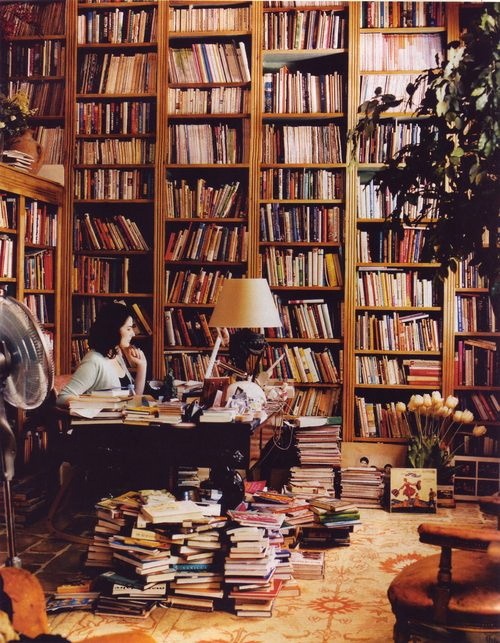
Nigella Lawson's private library. Image courtesy bookmania.me

Nigella Lawson’s private library. Image courtesy bookmania.me

Since I was old enough to buy my first Nancy Drew with my very own money, I have surrounded myself with books. I buy, borrow, give, and receive books with a pure, transactional joy that should be acquisitive but isn’t. Really, I just love books. I love stacking them, collecting them, rearranging and classifying them. I love holding them and writing in their margins, and of course, I love reading them.  The book, as an object, is comforting to me. It doesn’t matter if I’ve read it five times or never heard of it, books are totems. They are, quite literally, a mental escape hatch, and in that way they are an incredibly significant part of my personal growth.

I can trace my development as a person back through my reading material, from Laura Ingall Wilder’s Little House books to A.S. Byatt, Dorothy Parker and Anais Nin. Each phase in my reading reflects an emotional phase in my life, and the books that I read during those phases are, in essence, relics of the person I was. My books are a map of my past, and an indicator of future interests and selves. So yes, I have a old-fashioned fetish. I attach spiritual significance to books. I will never read every book I own, and I will never own enough… That doesn’t mean I’m not going to try.