
Comfort Reads

Black and white photograph of a kitten covered by pie dough in a pie. For Comfort Reads by Malin James

Kitty Pie by John McEnery

A comfort read is a book, author, story or snippet that, you guessed it, you find comforting. By “comforting” I don’t mean that it necessarily makes you happy. It also doesn’t have to be inspirational or uplifting. A comfort read can be dark, superficial or random. You can read it in its entirety or take a quick dip into a specific chunk.

Comfort reads are the literary equivalent of a teddy bear and, like a teddy bear, they give you that cozy, quilted, everything-is-going-to-be-okay feeling. I have a friend who used to read H.P. Lovecraft when she felt blue or depressed. She said that the wrongness made her feel better, if only for a little while. She was a tough, pragmatic, practical woman. Lovecraft was her teddy bear, and Lovecraft never failed her.

Recently, I’ve been thinking about comfort reads and how valuable they are. Personally, 2016 has been rough. Unfortunately, a lot of other people seem to have had an equally hard time of it. Whether from job loss, divorce, death, trauma or very bad luck, I’m far from the only person who took some knocks this year. Add that to the social and political climate we find ourselves in and crawling into a book for a break sounds pretty damn good.

Of course, the thing I have to keep telling myself is that there’s a difference between a break and becoming a hermit (though my, how tempting it is…). My friend was right when she said that Lovecraft’s wrongness made things better, but that’s temporary magic. Reality will always be there, waiting for you to address it. That’s why dipping into a book that’s comforting and familiar is a great way to split the difference between taking a mental beating and completely checking out.

Comfort reads aren’t necessarily favorite books or authors (though they can be). They’re individual, self-selected bits of time out of time. They may be as long as a whole book or as short as a page, but the main thing is that they are both finite and personally comforting. They give you time and space to recharge before jumping back into reality, and that can make a huge difference when you desperately need an emotional break while handling Important Things That Must Be Done Soon.

I know it sounds obvious, but comfort reads serve an important function. A few weeks ago, I wrote a post on my other blog that touched on the fact that there’s only so much stress the brain can absorb before it numbs to the stressor. Eventually, your mind gets tired of resisting so you either disengage or get swamped by whatever’s going on. It’s right about when I hit that overwhelmed place that I reach for a comfort read.

I’m an ex-bookseller and a former librarian, so my impulse is always (seriously, always) to make book recommendations, but I’m not going to do that here. You can’t really predict or recommend comfort reads. While my friend’s go-to in tough times was H.P. Lovecraft, other people probably wouldn’t get the same gentle fuzzies from Elder Gods and ichor. Conversely, no other writer of eldritch wrongness ever worked for her (sorry Clive Barker). Just like you can’t predict which blanket your kid is going to love to literal pieces, no one can predict your lexicographic woobie. You kind of just end up with it.

Personally, I have three comfort reads. The Bloody Chamber by Angela Carter, a handful of the Sherlock Holmes stories by Arthur Conan Doyle and Mina’s chapters in Bram Stoker’s Dracula. While these books are some of my favorites, that’s not what makes them my comfort reads. I love The English Patient, but it’s not a comfort read – not for me, at least. Same with Neil Gaiman, Dorothy Parker, cheap romances and The Thin Man. I love those books so very much, but they aren’t the literary equivalent of a duvet and hot chocolate on a rainy night. Everyone’s comfort space is different, which is why people find theirs when they need it. Need is the driver, and it doesn’t always lead you where you think it will.

While it’s incredibly important not to check out of your life til the clouds part, it’s also important to allow yourself a little mental slack if you’re running off the rails. There are, quite legitimatley, times when you just can’t absorb anymore. That’s when sinking into something comforting and familiar can make the difference between staying engaged and becoming a permanent hermit. It’s the break you allow yourself so you can come back out and tackle the Elder Gods of life.

On Depression and the Value of Contentment

There is a photo of me from when I was about three years old. I wish I knew where the was, but it’s fallen into the void of my mom’s house. In the photo, I am wearing my “polka-dotty dress” which is white with tiny red polka dots and a red ribbon around the waist. It is my favorite dress and I feel extremely sassy in it. I have my dimpled hands on my hips and I’m grinning down at the camera from the top step of a porch. The sun halos me from behind, soft and orange in early eighties Kodachrome, but it’s my smile that Iights the image up. This is the last visual image I have of myself as a fundamentally happy person.

When I say “happy person”, I don’t mean “happy” in a situational or contextual sense. I have been happy many times in my life, and I have many happy memories to go with them. Wide-ranging conversations make me happy.  Reading a book on a rainy day makes me happy. My daughter’s grin makes my heart burst with happy. Infusing honey with lavender before the house wakes up makes me happy. The happiness that I feel in these moments is real, but it’s also contextual, not fundamental to me as a person.

I was happy because something made me happy. Happiness as a result of an external influence, not an integrated state of being. They exist like flashes in the brain pan of my day,  pulling me up out of a naturally neutral state. It’s not that I walk around unhappy – it’s more that  my resting state is  grave, depressed in the literal and clinical sense.

I am a depressive, but I am not anhedonic . I feel pleasure. I feel happiness. But neither are consistent or independent of external influence. Contentment is. I am, if not happy,  profoundly content.

For young me, “contentment” was the opposite of “really living”. It meant that you had settled, and I was not going to settle. I was going to blow out my emotional credit limit and pay the bill in my thirties.  Paying the bill was rough – necessary but rough. Five years of therapy later, I am modulated and mindful and wildly functional. I am also gratefully content. Ironically, contentment is, for me, its own kind of joy. It’s not the champagne of pure happiness. Rather, it’s the mulled wine of a hard won stability, which makes me very happy.

It’s lovely to feel that my life is good and complete. While contentment doesn’t eradicate the need for ongoing effort (some struggles have deep roots), but I feel myself to be in balance. My contentment is as fundamental to me as my gravity and neutrality. The scale still tips one way and the other, but it returns to it’s baseline, which is a strange and happy thing.

*Side Note:  I should explicitly state that what I’m describing isn’t the difference between being depressed or not depressed. Depression isn’t as simple as happy vs. sad, nor is depression synonymous with sadness, as any depressed person can tell you.

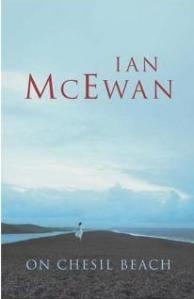
On Chesil Beach by Ian McEwan

Woman in a library art nouveau for On Confronting Literature by Malin James

Dig by Sadie Wendall (1909)

On Books that Quietly Confront

I’ve had On Chesil Beach since it released in 2007. It’s a lovely little hardback and I picked it up without even looking at what it’s about because I love Ian McEwan. I remember taking it home and doing the rare thing of sitting down to start it right away (I usually buy books and put them in the long, long, long line of my TBR). But I got two pages in and stopped. I felt vaguely ill and I stopped. I slowly closed the book, set it on the shelf with my other McEwans and moved on without trying to think too much.

In the years since then, On Chesil Beach has sat on my shelf, biding its time. I say “biding its time” because it felt like an active presence in its own quiet way. I’d pull other books off the shelf to read, or to cull or consider, and think – I know you’re there. I’m going to read you, but I’m not ready yet. 

I couldn’t pick the book up, but I still mentally addressed because, in an odd way, it didn’t feel like an object. It felt like an experience I was going to have to have, one that was waiting patiently for me. It’s the most gently confrontational book I’ve ever read because the confrontation was very specific. Two pages in, it was clear that the experience of reading On Chesil Beach was going to be deeply personal. So I set it aside until I could process why. Here’s why:

I recognized too much of myself in those first pages. The situation in that narrow book resonated in a way that drew a personal line for me between literature that confronts by design (think Tampa or American Psycho) and literature that resonates to the point of confrontation. For me, On Chesil Beach is the latter, and it’s a very different thing than the former.

Literature that confronts by design is meant to challenge – you know what you’re getting into before you even start. Whether the challenge is emotional, psychological, moral or social depends on the book, but regardless of how it challenges, its intention (at least in part) is to challenge. I love a great many books that do this – The Driver’s Seat by Muriel Spark; The Cement Garden by Ian McEwan; Tampa by Alyssa Nutting and loads of others – some that I’ve actively enjoyed and others that were difficult but which I appreciate nonetheless.

That appreciation comes from the distance the intended effect allows me to have. If I pick up A Little LifeI’m going to brace myself for the experience of reading it. Same with An Untamed State. That doesn’t mean I won’t be emotionally affected – far from it. What it does mean is that the effect will very likely be tempered, somewhat, by two things – the fact that I was expecting it and the fact that others have been similarly affected by the book.

Cover of On Chesil Beach by Ian McEwan for On Confronting Literature by Malin JamesLiterature that resonates to the point of confrontation is different. For books like this, the confronting element is purely accidental and often deeply personal. On Chesil Beach is a perfect example. Nothing about it is directly confrontational – it’s about a young couple and their disastrous wedding night. No one gets killed, maimed, or traumatized. However, when you scratch the surface, it’s about a young woman’s complicated relationship with sex in the wake of sexual abuse, and the damage it does to her relationship. While it isn’t about trauma, it’s about the effect of trauma and that resonated with me in a deeply personal and challenging way.

Though the situation in the book is very different (and quite a lot simpler) than mine, it reverberated enough to feel dangerous when I first bought it. I’d suppressed a great deal and was, at the time, unprepared to examine large chunks of my childhood, my sexuality, my personality and my sexual / romantic relationships. This subtle, gentle book hit close enough to home that I knew within two pages that it was going to make me confront things I wasn’t prepared to acknowledge, so I set it aside and let it wait for me.

The fact that I was drawn to reading it now signals an important shift. I avoided it for years with the conscious understanding that I would “read it when I’m ready”. That I pulled it down from the shelf last week and read it in two days means that my relationship to those things I was trying to protect – memories of my childhood, my sexuality and my perceptions (of both myself and my relationships) – are strong enough now to bear the acknowledgement reading the book would mean.

Literature intended to confront is an important part of how you might understand experiences beyond your own. It’s a way to engage empathy and understanding and broaden your mind. Literature that resonates to the point of confrontation has the opposite effect. Rather than looking outward, it’s a passage inward to your personal experiences, one that can deepen your understanding of how you move through life.

Sometimes that’s a joyful thing. Sometimes that’s incredibly difficult. Either way, there’s great value in the challenge – so much so, in fact, that there’s nothing wrong with waiting until you’re able to process that value in a healthy productive way. It’s the difference between engaging your history and triggering yourself. When in doubt, opt for the approach that allows you to engage without hurting yourself.