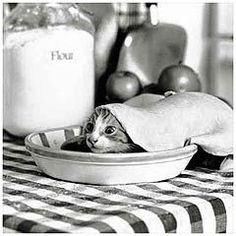
Kitty Pie by John McEnery
Comfort reads are the literary equivalent of a teddy bear and, like a teddy bear, they give you that cozy, quilted, everything-is-going-to-be-okay feeling. I have a friend who used to read H.P. Lovecraft when she felt blue or depressed. She said that the wrongness made her feel better, if only for a little while. She was a tough, pragmatic, practical woman. Lovecraft was her teddy bear, and Lovecraft never failed her.
Recently, I’ve been thinking about comfort reads and how valuable they are. Personally, 2016 has been rough. Unfortunately, a lot of other people seem to have had an equally hard time of it. Whether from job loss, divorce, death, trauma or very bad luck, I’m far from the only person who took some knocks this year. Add that to the social and political climate we find ourselves in and crawling into a book for a break sounds pretty damn good.
Of course, the thing I have to keep telling myself is that there’s a difference between a break and becoming a hermit (though my, how tempting it is…). My friend was right when she said that Lovecraft’s wrongness made things better, but that’s temporary magic. Reality will always be there, waiting for you to address it. That’s why dipping into a book that’s comforting and familiar is a great way to split the difference between taking a mental beating and completely checking out.
Comfort reads aren’t necessarily favorite books or authors (though they can be). They’re individual, self-selected bits of time out of time. They may be as long as a whole book or as short as a page, but the main thing is that they are both finite and personally comforting. They give you time and space to recharge before jumping back into reality, and that can make a huge difference when you desperately need an emotional break while handling Important Things That Must Be Done Soon.
I know it sounds obvious, but comfort reads serve an important function. A few weeks ago, I wrote a post on my other blog that touched on the fact that there’s only so much stress the brain can absorb before it numbs to the stressor. Eventually, your mind gets tired of resisting so you either disengage or get swamped by whatever’s going on. It’s right about when I hit that overwhelmed place that I reach for a comfort read.
I’m an ex-bookseller and a former librarian, so my impulse is always (seriously, always) to make book recommendations, but I’m not going to do that here. You can’t really predict or recommend comfort reads. While my friend’s go-to in tough times was H.P. Lovecraft, other people probably wouldn’t get the same gentle fuzzies from Elder Gods and ichor. Conversely, no other writer of eldritch wrongness ever worked for her (sorry Clive Barker). Just like you can’t predict which blanket your kid is going to love to literal pieces, no one can predict your lexicographic woobie. You kind of just end up with it.
Personally, I have three comfort reads. The Bloody Chamber by Angela Carter, a handful of the Sherlock Holmes stories by Arthur Conan Doyle and Mina’s chapters in Bram Stoker’s Dracula. While these books are some of my favorites, that’s not what makes them my comfort reads. I love The English Patient, but it’s not a comfort read – not for me, at least. Same with Neil Gaiman, Dorothy Parker, cheap romances and The Thin Man. I love those books so very much, but they aren’t the literary equivalent of a duvet and hot chocolate on a rainy night. Everyone’s comfort space is different, which is why people find theirs when they need it. Need is the driver, and it doesn’t always lead you where you think it will.
While it’s incredibly important not to check out of your life til the clouds part, it’s also important to allow yourself a little mental slack if you’re running off the rails. There are, quite legitimatley, times when you just can’t absorb anymore. That’s when sinking into something comforting and familiar can make the difference between staying engaged and becoming a permanent hermit. It’s the break you allow yourself so you can come back out and tackle the Elder Gods of life.
 Madeleine James