The Second Letter

The letter to which you have yet to respond was the one that I wished for you to see – stymied expression of feeling that I could, under the circumstances, respect. The letter, which is the last that I shall send, was sensible and restrained, full of curated lines and unspoken words. It was written from the high ground, a lovely, unregrettable view.

Unsatisfying.

The letter that I am writing now, (which, for the sake of my pride, I will not send), is the one that I wished to write. It is not smooth. It is not measured. I am writing on my skin, down the length of my leg and up again, higher and higher, to the hollow places that you kissed. I will start at my hip and scrawl, “To my terrible love,” on that curved, hard bone. I will write of the cruel silences that my tongue could not fill; of the envy that I swallowed to keep your taste in my mouth. I understood your responsibilities, your conditions, your life. I embraced my confinement in a small, lush room.

I was your escape, you said, as you kissed up my thigh. It was creamy and white when you suckled on my skin – a clean, sweet expanse of improbable trust. I rose to meet the specifications required by your precise, exacting love, you alchemist. I became an extension of you.

You worked your chemistry with every murmur and bite. Your fingers drifting over my fine cotton blouse, your hot mouth lapping the salt from my neck, I love you, I love you, I love you, you said. More ink on my skin.

I became an arching back, a twisting neck, a grasping, sucking need hungry for your rich, invisible ink. I folded myself like a paper crane and tucked myself into a pocket room – a bottle and its djinn, a ballerina in her pretty little box….

I sent you the letter that I wished for you to see. Now, I cover my skin in my very own ink, thick and black, from my pen. When every kiss is covered, I will wash the ink away. Perhaps it will stain the claw-foot tub you loved.

You are in me and on me. Your name is in my bones. I will soak and scrub until it dissolves, and the water and ink go cold. I will write until I am calm. Because I am not calm. I am not calm. I am not calm, terrible love. You are an ill-fitting skin.

Small Fiction: Cold War

Black and white historical photograph of a woman standing at the Berlin Wall circa 1962 for Flash Fiction: Cold War by Malin James

Berlin Wall, c. 1962

She was prone to overthinking. Aggressive, determined thinking  formed a wall around the process of life, which she could not control. She deployed distractions and analysis with Soviet subtlety, creating, over time, a network of protections. One department no longer knew what the others were doing. Left hand fooling the right.

She did this cloak and dagger for years – years and years and a lifetime – until cuts were made, and a colder, less stable government dismantled the agency of her cognition. Even concrete crumbles with age, but habits are hard to break, especially the girders in a foundation. The woman became a mouse in the concrete wall, sealing the cracks up with crumbs.

Small Fiction: The Couch

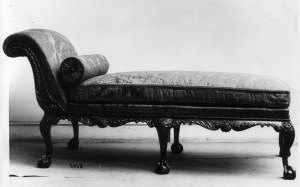
Black and white historical photograph of a 19th century chaise lounge for Flash Fiction: Grounded by Malin James

19th c. chaise lounge

She sits on the  dubious comfort of a well-intentioned couch. It had once been roly-poly, but its horsehair stuffing had been flattened by time and use. Now, it was a child’s drawing of the thing it’s supposed to be.

Equally dubious, she sits on the aspirational couch and allows Dr. Salt to prod at her equally flattened softness. Resentfully, she feels her stuffing begin to ooze. She sets her jaw and jams it back in. She does not like Dr. Salt, but she had promised Henry. Sadness has made her difficult to live with.

Dr. Salt’s techniques are reasonable, but they strike her as somewhat sinister. He calls them “grounding”, as if she were lightening that must be bottled.

How does the couch feel, Dr. Salt drones. Tell me, how does it feel?

Dr. Salt, she thinks, looks determined.

“Dead”, she replies. She is determined too, and it shows on her face, which is cool, and smooth, hard. Very unlike the couch.

Dr. Salt’s brow furrows with clinical concern. She frowns and sees that she’d better explain.

“The couch is an object, Dr. Salt. In terms of feeling, it’s a dead thing. It has no nerves, no skin. There is nothing to hurt. Or is that not what you meant?”

Dr. Salt is quiet.

She plucks at a loose thread in the brocade, certain that she is not causing pain.

Agnes, The Maid

This is a short portrait / character sketch. Sometimes it happens that I get a character without a story. Usually it’s a character I quite like and will come back to later, either in their own piece, or as a tertiary character somewhere else. Agnes is one of these characters…

Agnes, The Maid

No one used a feather duster like Agnes. The command with which she wielded a batch of feathers shoved into a stick was truly terrifying. Even the mistress stayed

out of her way, not daring to test the sideboard after Agnes had been through.

Agnes was a narrow sort of woman, rather like an obelisk, with an air of authority that made her seem far taller than she actually was. Even as a child in the first blushes of youth, there had been little of the girl and even less of the blush about her. She was made of serious stuff. Lest you forget, the line of her mouth would remind you, before her shoulders squared off like a coat rack, and she took up arms against the dust.

Serious as she’d been as a girl, Agnes had had hopes – hopes that had been dashed quite early on in her career as a person. As a girl she had wanted to join the cavalry and go to war like her father, who’d been a sergeant in the Boer Wars. When her father had informed her that daughters did not join the cavalry, that this honor was only for sons, and that even if they did join the cavalry, his daughter would certainly not, Agnes had cried for hours. It was the last time in her life she would cry.

Finally, touched by his daughter’s rare show of emotion, Agnes’s father relented upon one nonnegotiable condition. If she were determined to go join the army, it would be the infantry for her. No “prancing about on ponies” – not for his girl. She would charge into war like a man. Though she was by no means un-heroic, the “ponies” had rather been the point. But her father would not be moved. She joined domestic service instead. Agnes never forgot her dream though. It was her one great disappointment. It would affect her, subtly, for years.

Despite her lowly role as maid, she wore her uniform with military precision. The sheer force of her personality endowed her ruffled cap with an air of authority, as if the cap knew itself to be overly frilly, and had tried to sharpen up. She took orders and conveyed orders with the bearing of a much older person. And, of course, the house had never been so utterly free of dust.

Agnes rose efficiently through the ranks to head housemaid after only two years, and it was assumed that when the housekeeper retired, Agnes would take up the helm. With the confidence of authority, Agnes felt this to be true. She was, after all, a nearly perfect servant. Her only flaw was the aggression with which she dusted the house. It called to mind a general, spitting on enemy armies before crushing them in his, (or her), wake.

Tank, or Gentleman Scholar

Image courtesy of http://en.wikipedia.org

If there were ever a man like a mountain, Tank was not that man. Physically, he was more of a molehill, though his intellect towered over men three times his size.

Upon his birth, Tank had very nearly been named Theodore for his mother’s favorite brother. But Tank’s father, in a rare burst of filial interest had insisted that he should name his son, and that his son’s name should be Tank, not for any particular reason, except, perhaps, that he’d been drunk.

Despite the name’s dubious implications, it had gone on the birth certificate, and so Tank had been “Tank” for the entirety of his life, save, in quiet moments, when his mother had coo’d “Theo” in his ear. It was the distant memory of his mother’s voice that sallied him through years of quizzical looks and disappointment, (on his father’s part, at least), for the fact that his physical prowess failed to match either his name or his mental acumen.

How he would have loved to be Theodore – perhaps then he wouldn’t have been quite such a disappointment. Theodore’s did not lay bricks for a living, nor did they brawl or curse or spit. Theodore’s sipped brandy in book lined rooms and thought important thoughts, pausing, only briefly, to write the most important ones down. Theodore’s became scholars and architects, and left the brick laying to men named Tank… though not this particular Tank.

In awesome defiance of his father (and to his mother’s quiet pride), Tank excelled academically. His first very good school led to a second very good school, which in turn led to an impressive university career. It was at university that Tank discovered, and pursed, his love of etymology.

Tank’s calling found him one afternoon, as he was researching his own name. It was indeed true that the verb form of “tank” meant “drunk,” and had since 1893, but the noun form held a special light of hope. In the original Portuguese (brought west by way of India in 1616, from the Gujarati “tankh”), the word referred to an underground reservoir of water, and it was to this idea of hidden depths that Tank held firm.

His desire for Theodore slowly waned beneath the weight of his etymological studies and academic success. By the time he published his magnum opus, a thirteen volume tract called simply, Names, Tank was at ease with himself and his once dubious moniker, signing notes of thanks for various scholarly offers and congratulations, With Most Cordial Regards, Dr. Tank McGuinness.

Bluebeard’s Clever Wife

For a bit of levity at the end of the week, I’m posting a little story I wrote. It’s a fairy tale and it’s a bon bon, but it’s tiny – tiny enough to swallow whole. I hope you enjoy…

Bluebeard’s Clever Wife

Once upon a time, a girl married a man. He had a shady reputation, but she thought he was kind of cute. Plus, he was rich – not that she noticed, of course. So they married, and went to live in his castle, which was very nice and extremely isolated because he liked his alone time.

One day, shortly after they married, he told her that he had to leave on business. He gave her the keys to every lock in the house and told her she could open them all, except for one.

“Don’t, under any circumstances, open that door,” he said, pointing to a black oak door with a large iron lock. “If you do, I’ll have to kill you. Fair warning.”

Then he left.

Always a dutiful soul, she waited until the door closed behind him to go to the forbidden room. What she found shocked her. Bits and pieces of his former wives were scattered about like puzzle pieces. Hands, torsos, heads… the place was a wreck. Unable to stand the mess, she went to work reassembling the ladies, until they were all lined up, neat as pins.

She was just congratulating herself on a job well done when her husband came back home. Apparently, it had all be nothing but a test. When he discovered her in his secret room, he was understandably upset, but she impressed upon him importance of keeping things tidy. Then she showed him her improvements, which included a clever little bucket for miscellanious parts.

Bluebeard was so struck by her logic, and by the convenience of having everything close to hand, that he quickly forgave her with a hearty laugh. From that day forward, he left the door unlocked, while she, inspired by her husband’s hobby, took up the study of anatomy. They lived happily ever after.