Found in Translation: 8 Easy Gateways into Japanese Literature

It’s taken me an embarrassingly long time to dig into contemporary Japanese literature. When I ask myself why, the answer is usually something like “uhh…translation feels a little scary?”, which leaves me feeling pretty dissatisfied with myself. Having acknowledged this as my starting point, I thought I’d share some titles that got me from “translation’s a little scary” to gobbling up authors like Banana Yoshimoto and reading manga with my teen.

It’s all about finding accessible gateways. This will vary per person, so these titles are only a starting point. There are amazing genre translations in mystery, romance (especially in manga), horror, fantasy, science fiction and what I tend to think of as “cool, speculative, slippery stuff”, so the sky is the limit. 

Manga:

My Hero Academia by Kohei Horikoshi: Don’t let the yelling or flashy fights scare you away from this shonen masterpiece. These characters will make you feel, and it’ll give you a cultural keyhole into everything from school life, the collective good an appreciation for cold soba and mappo tofu.

Bungo Stray Dogs by Kafka Asagiri: This is the ultimate manga for book lovers. “Bungo” means “classical or literary Japanese”. All of the characters are named for writers in the Japanese and Western canons, and the mysteries are full of familiar references and tropes. If you want literary easter eggs and a primer in Japanese literature, you can’t beat it. 

On the other, darker is anything by Junji Ito. If you’re into horror—body horror, literary 

horror, paranormal horror, psychological horror, literally all the horror—check out this prolific horror manga artist. Although he’s easiest to find in the manga section, he’s also done full length works, novel adaptations, and illustrated short stories, so odds are, he’s done something that will make your skin crawl.

Light Novels:

The Apothecary Diaries: Specifically, the light novels by Natsu Hyuga, not to be confused with the manga. What’s a light novel? It’s just the novel version of a manga, (the versions often exist side by side) Personally, I find LN’s to be a little more accessible, given that I didn’t grow up reading back to front, but either way, you’re getting a great story.

The Apothecary Diaries features Mao Mao, one of the driest, most no-nonsense heroines I have ever read in any genre. The series follow Mao Mao, a young apothecary from the pleasure district to servitude in the Imperial Palace where she sleuths out mysteries like an impatient, poison loving Sherlock Holmes.  It also features a super satisfying slow-burn romance with Jinshi, her not-quite Watson.

Short Story collections / Short Novels: 

Before the Coffee Gets Cold by Toshikazu Kawaguchi. This is a collection of inter-related short stories that take place in a cafe in Tokyo where you can go back to a moment in time. This was a poignant, universal read that gave me a lot of strong, quiet feelings.

Revenge: Eleven Dark Tales by Yoko Ogawa. Ogawa has written everything from short, achy books like The Housekeeper and the Professor, to The Memory Police which is set in an authoritarian dystopia that made my stomach hurt. Revenge is a tight, mean little collection that gives you all the bite and darkness of a weird true crime series.

Kitchen by Banana Yoshimoto. Oh, my gosh, I love Banana Yoshimoto! You can’t go wrong by picking up anything she’s written, but Kitchen is my favorite. It follows the friendship between a young woman mourning her grandmother and the young man who invites her to live with him and his trans mother.  It came out in 1988, but it feels shockingly contemporary, especially in the way Yoshimoto handles gender identity and the gray zones in relationships. 

After Dark by Haruki Murakami. Murakami comes with a lot of baggage, so I hesitated here. But the fact is that regardless of baggage this short novel was insightful, engaging and fun to read. Everything happens over the course of a single night as we follow Mari, a young woman in a Tokyo Denny’s. There are surreal elements, but they’re woven in so tightly that I barely noticed. It’s a good place to start with a polarizing cultural powerhouse.

These titles are just the tippy tip of the iceberg. There are as many doors into Japanese literature as there are people interested in stepping through. Don’t let the idea of translation stop you from dipping in your toe. The water’s just fine. 

Lunch with Zelda

originally published on Queen Mob’s Tea House

I am not an archivist. I’m a consulting records appraiser, which is low in a departmental hierarchy, but I like it. I move on when my contact it up, and I’m usually ready. I was especially ready after six months at the National Archives.

My contact at the Archives was a well-intentioned post-grad named Maggie. Maggie was earnest enough to labor under the false impression that co-workers should bond. After six months, I knew more about her cat than anyone should. 

Maggie was nice though and I liked her well enough, so we arranged to have lunch on my last day. We were on our way out the door when a gaggle of archivists called her name. They were celebrating someone’s promotion and wanted to know if Maggie could join them. Maggie looked torn and it got awkward real fast, so I jumped in to tell her to go ahead.

I was people’d out and happy to grab a sandwich on my way home, but Maggie is a social person and can’t imagine anyone being happy eating lunch alone with a podcast. Before I could stop her, she asked if I could come too.

There was an even more awkward, agonizing pause before a mulleted ape of an archivist said, (really grudginly) “yeah, like I guess. If she wants to”. The implication was very much that she hoped that I wouldn’t want to. The subtext was so textual that I smiled brightly and said “I’d love to come.”

Petty? Absolutely. Plus, I most certainly would not have loved to come, so I screwed myself over too. I was just reactively pissed. It’s not like Martha Lynn Baxter (the archivist ape) and I were strangers. We had worked together, (albeit unpleasantly), for six months, and I was standing next to her well-marbled ass when she extended her grudging invitation, so I’m petty, but she’s rude. Screw you, Baxter.

Zelda, who was also in the room, met my eyes. Zelda is my mountain lion. We’ve always been together. When I was a girl, she was a cub. Now that I’m in my thirties, she’s a lithe, fully grown puma, (no fucking courage jokes, please). This sort of thing runs in my family. My mom has a cheetah named Richard. They’re in their golden years now, so they bustle more than run, but they’re just happy together. That’s how it is with me and Zelda. Content to be on our own….

Anyway, now our tolerable one-on-one lunch had turned into a clusterfuck of a group activity. At least they were going to a Greek place. Zelda loves Greek.

The whole gaggle trooped to the restaurant in two’s and three’s. I walked with Zelda behind the main group. It was actually kind of sweet the way they marched down the street like homeschooled kids on a fieldtrip. Not having lunch at their desks was clearly a big deal.

The restaurant was super small, so the waitress with a bobcat girded herself as the archivists dove for seats, jockeying for position like it was high-stakes musical chairs. I hate musical chairs. I waited for the feathers to settle and took a seat at the end of the table. Zelda curled up at my feet. 

Spare staff hurried out with flat bread and fresh olives, which were absolutely delicious. Much to their credit, no one stepped on the tawny tail sticking out from under my chair. Meanwhile, the conversation rolled on, fueled by the first of four bottles of wine.

I closed my eyes. These people talked a lot, but now, thank Christ, to me, overall. Zelda was grumbling under the table, making do with the olives I slipped her while we waited for her lamb. Zelda has a punctual appetite and she gets cranky when her food is not equally punctual. With a cafe that small and group that big, it wasn’t surprising that the food was long in coming. I kept slipped her appetizers, hoping that if I gave her enough olives, the worst wouldn’t happen. This was optimistic, but you can only do your best. It’s not like I could make the kitchen move faster. 

So, the conversation flowed around the boulder of my presence, and Zelda shifted restlessly and wuffled against my ankle. I looked down and stroked her ear, which she finds soothing. I find it soothing too. Pretty soon, I was daydreaming.

“So, what’s next?”

I looked up. My old buddy, Martha Lynn Baxter, had deigned to address me. “Sorry, what was that?”

“What’s next,” she said again, pitching her voice to be heard above the chatter. “What are you going to do?”

“About what?” I asked.  I knew what she meant. I’d been passed up for a permanent position. I met her eyes and let my face slip into neutral.

“Oh, well,” she said, recalibrating her approach. “You know. Tenures don’t grow on trees.”

I smiled, trying to pass for a nice person. “Sure don’t. I’ll shake some bushes. Something will come up.”

“Whatever you say,” she said, smiling her simian smile. “Hey, I feel like I should tell you, I was the one who voted against you for the tenure position.”

I raised my brows. I wasn’t surprised by what she’d said, but I was shocked that she’d said. I looked around the table but everyone as still chatting as if she’d asked how I liked my ice tea. “Did you really,” I said, modulating my tone. Zelda gets agitated when I’m pissed. She must have sensed something though because she growled under the table. Her stomach followed. She was probably hangry. I checked the breadbasket. Empty. No sign of the waiter either. I bent and stroked her ear. Zelda shook my hand off and rounded the table before slipping back under the tablecloth.

Baxter nodded and shrugged. Baxter’s got balls, I acknowledged with reluctant respect.

“I”d love to know why,” I said, silkily.

“It was nothing personal,” Baxter said, bluffly assured. “I just couldn’t stand the thought of looking at your smug fucking face every day until I retire.”

I heard Zelda licked her chops beneath the table. I made meaningful eye contact and shook my head. She ignored me and bit Martha Lynn Baxter’s foot clean off. Baxter looked at me, expectantly. She had no idea that Zelda was tucking in.

“What do you have to say to that?”

“I’m sorry?” I asked. It’s not like me to drop a conversational thread, but having just finished her foot—clog and all—Zelda was gnawing her way through Martha Lynn’s savory calf.

“To the fact that lost a job because you’re so fucking unlikable,” Baxter clarified, oblivious to the animal chomping at her leg.

“Not much to say, is there,” I said. 

“Guess not,” Baxter jerked in her chair as Zelda gnawed at her belt. She settled back down when Zelda made it through. Martha Lynn Baxter stared at me, retaining her focus while Zelda chomped at her torso. That kind of focus is serious. I began to wonder about her.

Moments later, the waitress put Zelda’s lamb on the floor. I murmured my thanks and nudged it with my foot. Zelda probably wouldn’t eat it now. Maybe for dessert…. Across the table, what was left of Martha Lynn Baxter (not much) attacked her risotto. Zelda was still nibbling. At this point, I was pissed, but holding it together like a fucking class act. I cut into my mousaka, conversationed out.

A few minutes later, Martha Lynn Baxter was gone, leaving behind half a plate. I reached over and took a bite. The risotto was excellent—subtle, creamy, perfect. I made a mental note to order it next time. 

“Where did M.L. go?’ Oblivious to her presence, Baxter’s assistant nudged Zelda with his shoe. Zelda licked her chops. Her whiskers stood out from her muzzle, as if to salute meal. I looked pointedly at her lamb. Zelda smiled her big cat smile and bit the assistant. I shook my head and cut into my lavash. The whole department could fuck itself.

After gobbling up her second course in three happy bites, Zelda proceeded around the table, purring as she went. Incidentally, mountain lions are the only big cats that can purr—they’re exceptional that way. I love it when Zelda purrs. It’s one of my favorite things.

The din of conversation grew quieter as Zelda worked her way around the table. I could finally hear myself think, thank fuck. I poured myself a glass of wine and ordered dessert, still not full despite having helped myself to half of Baxter’s risotto. I’d just finished my baklava when Zelda ambled back. The table was empty. She sighed, fat and satisfied. I signaled for the check, but it was already covered on the Archive’s expense account, which was a pretty sweet surprise.

Zelda and I collected our things. I was absolutely stuffed. The waitress came by with Zelda’s lamb wrapped to go, but neither of us could look at it so we offered it to her bobcat. She introduced him as Mel. Then they thanked us and we left. I hadn’t eaten that much in ages. I must have been hungrier than I thought.

THE END

The Second Letter

The letter to which you have yet to respond was the one that I wished for you to see – stymied expression of feeling that I could, under the circumstances, respect. The letter, which is the last that I shall send, was sensible and restrained, full of curated lines and unspoken words. It was written from the high ground, a lovely, unregrettable view.

Unsatisfying.

The letter that I am writing now, (which, for the sake of my pride, I will not send), is the one that I wished to write. It is not smooth. It is not measured. I am writing on my skin, down the length of my leg and up again, higher and higher, to the hollow places that you kissed. I will start at my hip and scrawl, “To my terrible love,” on that curved, hard bone. I will write of the cruel silences that my tongue could not fill; of the envy that I swallowed to keep your taste in my mouth. I understood your responsibilities, your conditions, your life. I embraced my confinement in a small, lush room.

I was your escape, you said, as you kissed up my thigh. It was creamy and white when you suckled on my skin – a clean, sweet expanse of improbable trust. I rose to meet the specifications required by your precise, exacting love, you alchemist. I became an extension of you.

You worked your chemistry with every murmur and bite. Your fingers drifting over my fine cotton blouse, your hot mouth lapping the salt from my neck, I love you, I love you, I love you, you said. More ink on my skin.

I became an arching back, a twisting neck, a grasping, sucking need hungry for your rich, invisible ink. I folded myself like a paper crane and tucked myself into a pocket room – a bottle and its djinn, a ballerina in her pretty little box….

I sent you the letter that I wished for you to see. Now, I cover my skin in my very own ink, thick and black, from my pen. When every kiss is covered, I will wash the ink away. Perhaps it will stain the claw-foot tub you loved.

You are in me and on me. Your name is in my bones. I will soak and scrub until it dissolves, and the water and ink go cold. I will write until I am calm. Because I am not calm. I am not calm. I am not calm, terrible love. You are an ill-fitting skin.

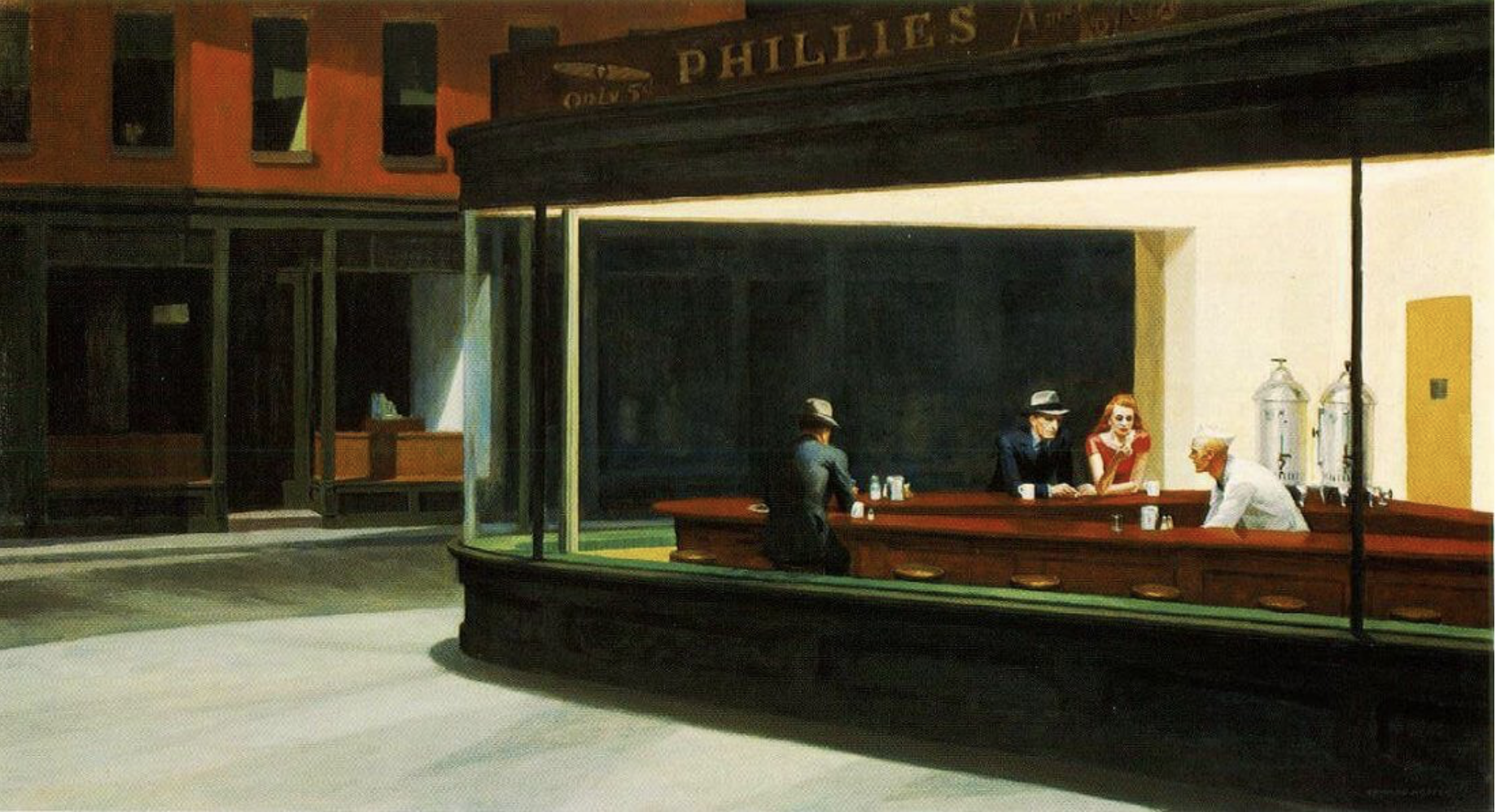
Fiction: Nighthawks

Nighthawks by Edward Hopper, 1942

Rose

Rose looked at her reflection in the polished mahogany counter. She didn’t look good. The day had caught up to her, stripped her color and sharpened her face. She dabbed at her lipstick with a napkin. Too red. It looked funny. Rose put the napkin down. She used to like that red. So had Eddie. Eddie had liked that color.

Red, red lips for my red, red, Rose….

Rose’s hand plucked at her earring, her coffee, her locket, before inching over to rest on Rob’s sleeve. She liked the feel of his woolen jacket under her quick, nervous fingers. Nice and warm. Solid. Rob. She sighed. It had been a long day. It was time to go. She wanted to say that. It’s been a long day. It’s time to go. But his downcast eyes trapped the words in her mouth. He wasn’t ready yet. She could wait.

Widowed at thirty. Thirty was too young for how she felt. For how she looked too. Her reflection looked worn out and old—not pretty anymore. Her eyes slid to the floor. She didn’t really care. Everyone was dead. Eddie was dead. The baby was dead. Her father—hers and Rob’s—was dead, but that was nothing to cry about. Their father had been a lucky son-of-a-bitch.

Rose glanced at her brother and stopped the thought, just in case he read her mind. Sometimes he could. He couldn’t, not really. But sometimes he knew. She couldn’t read his either, but sometimes…. She clutched her thick, glazed coffee mug with both hands, prepared to wait.

It’s been a long day. It’s time to go home.

She looked at Robbie’s profile, his hawkish face, and quietly looked away.

The dead weren’t lucky, but she felt like they were. She couldn’t say that to anyone, especially her baby brother. He didn’t need to hear it. He’d done enough already – more than she wanted him to. He’d visited her in the hospital and tied pink ribbons around her wrists. He came by or called every day. He worried so much. She made him worry.

You worry, Robbie. You worry too much.

She was tired. It was time to go home.

Rose sighed, a small, shallow breath. Everything was done. This time he’d have nothing to find. Poor Robbie.  She was glad they’d spent the whole day. Rose fingered her locket. The gold was warm. It felt soft when she pressed it. There was a picture of Eddie and the baby inside.

She glanced at her brother through her sweep of red hair. Red, red hair. Red, red Rose. Rob’s comfortable silence was the only thing she would miss. His face looked dark, like a shuttered house. No lights. Locked doors. She had to wait for him to be ready. They would sit together in this in-between place, coffee cold in their cups. When he was ready, he would take her home, and then she would go to Eddie and the baby. She loved her brother. She could wait.

Robert

Robert knew that she was going to try it again. He could read it like newsprint in the lines around her mouth. He missed her smile, her real smile, her cracking, half-cocked grin. He hadn’t seen it in months. Instead he got what she gave him now…pale lips under too much lipstick. Her hand was cold on his arm.

She’d gotten dressed up for their day out, special occasion dressed up—Hayworth hair, her favorite pink dress, she’d even worn perfume. But her bones were sharp beneath her collar. Her wrists were thin and hard. He wished she’d worn a sweater. It was turning cold, too cold for a thin, silk dress.

Why don’t you bring a sweater, Rosy?

I’ll be okay.

The second she’d said that, he’d known. That dress, her hair, her too bright face…he’d known exactly what was coming, and he didn’t want to know.

He lit a cigarette and let it burn. Tiny column of ash. Then he lit another. Beside him Rose shifted, patient, silent. She wanted to go home.

See you tomorrow, Rose

I love you, Rob.

Robert sipped his coffee. He should say something. He should stop her. But, Jesus, she looked spent up…. Rob glanced at his sister, though the sweep of her strawberry hair, but he couldn’t see her face. He wasn’t sure he wanted to. Robert signaled for the check. It was time to take her home.

“More coffee?”

Robert paused.

The waiter poured.

One more cup.

Charlie

Wish that kid would quit staring and do his job. Goddamn coffee’s cold.

Across the diner, the old man hunched over the counter like a bulldog over a bone. He eyed the yellow-haired waiter, who was eyeing the redheaded girl. Like staring was going help her. A gal like that never left her man, not if he beat her into the ground. After thirty years he knew.

Charlie rubbed his bum knee. He wished he could sleep. He hadn’t slept since he’d retired. Not a full eight hours. Not in a month. Best wishes, Charlie! Retirement—you lucky son-of-a-bitch!

Yeah. Real lucky.

Charlie leaned back on the hard stool, regretting the watch the boys at the precinct had given him. He hated fishing, hated crosswords. His buddies were still on the force. Doris was remarried and Katie was busy, making a life of her own. She’d even gotten a job—secretary at some firm. Smart girl. Katie had always been smart. Maybe not pretty, but smart. He could hear Doris telling her to dress up nice for work. Christ, he wished Doris would shut-up.

Charlie shot the waiter a look and clacked his cup softly. The kid strolled over, refilled it from the urn and handed it back to him. Up close, Charlie realized, the kid wasn’t much of a kid. Pushing thirty, he’d bet. Charlie grunted. At twenty-six, he’d already been on the force for five years. Guy should get a real job.

Charlie looked out the diner’s plate-glass window at the dark, disinterested street. What did you do when you got cut loose?  Kid’s got his whole life and he wastes it, like it’s something to toss away. The old man shifted. He was starting to hate that kid….

He should probably head home. It was a long walk back to his place. Maybe that would wear him out. He reached for his wallet, straining the seams of his suit. Cheap suit. Work suit. He took out his Luckies instead. One cigarette. One more cup. Then he’d toss a buck on the counter and take the long walk home. Back to his apartment. He hated that apartment. He hated the way it looked—half empty, full of nothing worth saying, like old newsprint. He hadn’t seen it that way before. He hadn’t had time—he’d barely ever been home. Now he saw every night. Charlie sucked the hot coffee between his teeth.

Christ, he wished he could sleep.

Joe

That lady looks sick. Joe glanced up from a tray of half-empty saltshakers. What’s she doing out so late with that guy, anyway? She looks like she should be in a hospital or something….

Joe shook his head and refilled the shakers without taking his eyes off the lady in the pink dress. He was good at working and watching. He never spilled.

Look at how she’s holding his arm, he thought. Like she’s gonna drown and he’s the only thing keeping her afloat.

That was good, Joe thought. He had to write that down. He stopped pouring and wiped his hands before getting out the little notebook he kept in his apron pocket.

He loved working the late shift. Nothing like it for writer’s block. Nothing like it for inspiration. The lady and her fella were great. He had to use them somewhere…maybe he’d put her in a sanitarium and make the guy her lover. And the guy… a private eye with a shady past? Maybe he broke her out and now they’re on the run. However Joe wrote it, it was gonna be tragic. That lady was tragic all over.

Joe glanced across the counter at the old guy sitting on his own. Not much there. Just a sad sack. He wasn’t as compelling but Joe could work with it. Maybe a tired crime boss or a has-been reporter. Joe studied the man nursing his hundredth cup of coffee. Thickset. Stubborn build. Angry mug. Joe nodded and grinned. He’d make the old guy the redhead’s father. Iron fist with heart of gold.

The old guy shot Joe a belligerent look.

Skip the heart of gold.

Joe shrugged. Even after he’d sold the novel, he’d still work the graveyard shift. He loved the diner at night. Nothing like it for writer’s block. Nothing like it for inspiration.

Joe pulled out a pen. Down the counter, the man paid the tab and helped the lady up. She stumbled. He caught her. Joe bent over his notes. He barely looked up as they left.

THE END

Portrait: Jean the Ambiguous

I love androgyny. I always have – from Marlene Dietrich in a tux to David Bowie in anything – androgyny is beautiful to me. It’s been a while since I posted a bit of fiction, so I dug into the archives, (i.e.: the ancient, dusty files on my hard drive), and unearthed this character study. After a bit of dusting off, I remembered by I’d written it – I rather love Jean. In fact, Jean will very likely end up in a story of Jean’s own. In the meantime, however, here’s a sketch of the fabulous Jean, who defies the constraint of labels and gender. 

Jean the Ambiguous

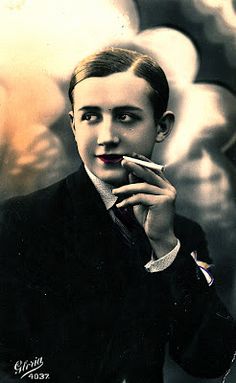
androgenous jeanOne can only begin to description of Jean by saying that Jean is French. Though Jean’s nationality has little practical bearing on Jean’s personal behavior (aside from a certain pronounced flair), the fact the Jean is French factors into a separate, pivotal, matter—the interpretation of Jean’s name. Or, to put it more succinctly, the choice of pronoun one uses reference to Jean.

You see, the French spelling of “Jean” is not “gender specific,” and neither, really, is Jean. If Jean were only English, (or American in a pinch), the ease of gendered spelling would see one through—“Jean” or “Gene”, “he” or “she.” The question of pronoun would cease to exist.

Ironically, the ambiguity of Jean’s name is a perfect reflection of Jean, which, though prickly to admit, is the root of the difficulty. One must also admit that a contributing factor is Jean’s stubborn (though admittedly suave) insistence on not offering any definitive evidence as to gender in either dress or manner. Allow me to clarify.

Jean is tall and slender – tall for a woman (though not unthinkably so) and quite average for a man. Jean’s hands are fine-boned, with long, rather sensitive looking fingers – Jean has the hands of a fine woman or an accomplished musician. Unfortunately, Jean’s income and fame are entirely due to the virtuosity with which Jean plays the violin, so there is little help there.

That’s all fine and good, you must be thinking, but one can surely tell a person’s gender from his or her manner of dress! In answer to this, I’ll admit that it’s true in most cases. But Jean’s manner of dress is unconventional for either sex—tailored suit with a flared coat; French cuffs and lovely jeweled links; a snowy white shirt with a ruffled front; dramatically high collar; crisply knotted tie. The lacquered longish hair adds to the confusion. Is Jean a woman with short hair, or a man with long? It’s impossible to tell.  The only thing one can say for sure is that Jean’s cologne, (or perfume), smells quite good.

So clothing is no help, and neither is bearing. There is always seduction in the large, smudged eyes; a feline smile on the pale, oval face. One moment, one is sure one has solved the riddle of Jean, only to see the picture change….

And so what is one to do? Ask leading questions? Jean smiles mysteriously, (or negligently or indulgently or flirtatiously), and one is dazzled but no closer to knowing which pronoun to use. And so the mystery continues, adding flame to the fire, and fueling the allure of the obsession that is Jean.

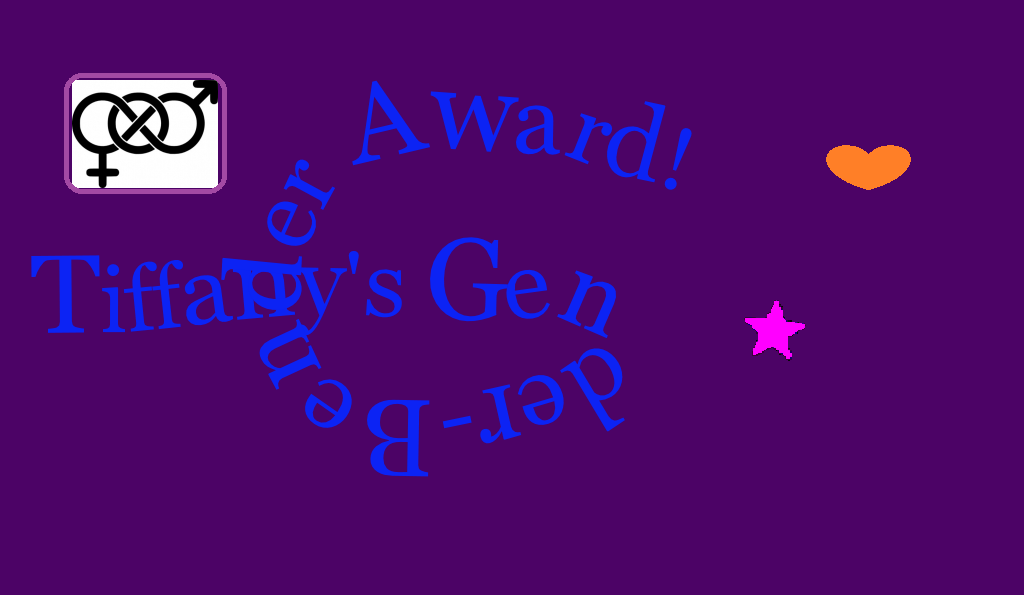
Note 3/16/14: Just this morning, I received the lovely news that this post was given the Gender-Bender Award by the lovely mind behind Tiffany’s Non-Blog. Needless to say, I’m quite honored that a character I’m so fond of turned someone’s head in such a wonderful way. Thank you so much!

gender-bender-award1

Agnes, The Maid

This is a short portrait / character sketch. Sometimes it happens that I get a character without a story. Usually it’s a character I quite like and will come back to later, either in their own piece, or as a tertiary character somewhere else. Agnes is one of these characters…

Agnes, The Maid

No one used a feather duster like Agnes. The command with which she wielded a batch of feathers shoved into a stick was truly terrifying. Even the mistress stayed

out of her way, not daring to test the sideboard after Agnes had been through.

Agnes was a narrow sort of woman, rather like an obelisk, with an air of authority that made her seem far taller than she actually was. Even as a child in the first blushes of youth, there had been little of the girl and even less of the blush about her. She was made of serious stuff. Lest you forget, the line of her mouth would remind you, before her shoulders squared off like a coat rack, and she took up arms against the dust.

Serious as she’d been as a girl, Agnes had had hopes – hopes that had been dashed quite early on in her career as a person. As a girl she had wanted to join the cavalry and go to war like her father, who’d been a sergeant in the Boer Wars. When her father had informed her that daughters did not join the cavalry, that this honor was only for sons, and that even if they did join the cavalry, his daughter would certainly not, Agnes had cried for hours. It was the last time in her life she would cry.

Finally, touched by his daughter’s rare show of emotion, Agnes’s father relented upon one nonnegotiable condition. If she were determined to go join the army, it would be the infantry for her. No “prancing about on ponies” – not for his girl. She would charge into war like a man. Though she was by no means un-heroic, the “ponies” had rather been the point. But her father would not be moved. She joined domestic service instead. Agnes never forgot her dream though. It was her one great disappointment. It would affect her, subtly, for years.

Despite her lowly role as maid, she wore her uniform with military precision. The sheer force of her personality endowed her ruffled cap with an air of authority, as if the cap knew itself to be overly frilly, and had tried to sharpen up. She took orders and conveyed orders with the bearing of a much older person. And, of course, the house had never been so utterly free of dust.

Agnes rose efficiently through the ranks to head housemaid after only two years, and it was assumed that when the housekeeper retired, Agnes would take up the helm. With the confidence of authority, Agnes felt this to be true. She was, after all, a nearly perfect servant. Her only flaw was the aggression with which she dusted the house. It called to mind a general, spitting on enemy armies before crushing them in his, (or her), wake.

Bluebeard’s Clever Wife

For a bit of levity at the end of the week, I’m posting a little story I wrote. It’s a fairy tale and it’s a bon bon, but it’s tiny – tiny enough to swallow whole. I hope you enjoy…

Bluebeard’s Clever Wife

Once upon a time, a girl married a man. He had a shady reputation, but she thought he was kind of cute. Plus, he was rich – not that she noticed, of course. So they married, and went to live in his castle, which was very nice and extremely isolated because he liked his alone time.

One day, shortly after they married, he told her that he had to leave on business. He gave her the keys to every lock in the house and told her she could open them all, except for one.

“Don’t, under any circumstances, open that door,” he said, pointing to a black oak door with a large iron lock. “If you do, I’ll have to kill you. Fair warning.”

Then he left.

Always a dutiful soul, she waited until the door closed behind him to go to the forbidden room. What she found shocked her. Bits and pieces of his former wives were scattered about like puzzle pieces. Hands, torsos, heads… the place was a wreck. Unable to stand the mess, she went to work reassembling the ladies, until they were all lined up, neat as pins.

She was just congratulating herself on a job well done when her husband came back home. Apparently, it had all be nothing but a test. When he discovered her in his secret room, he was understandably upset, but she impressed upon him importance of keeping things tidy. Then she showed him her improvements, which included a clever little bucket for miscellanious parts.

Bluebeard was so struck by her logic, and by the convenience of having everything close to hand, that he quickly forgave her with a hearty laugh. From that day forward, he left the door unlocked, while she, inspired by her husband’s hobby, took up the study of anatomy. They lived happily ever after.