The Night Watch by Sarah Waters

night_watch_318x500
On Structure and Chronology

There aren’t many writers I trust completely, but Sarah Waters is one of them. Regardless of where she takes me, I know she’ll get me there and back safely, whether it’s a Victorian insane asylum or an ambiguously creepy manor house post-WWI. In fact, her writing is pretty much guaranteed to do three things for me:

1. Emotionally affect me, often in very uncomfortable ways.

2. Challenge my expectations.

3. Teach me how to be a better writer.

Her fourth novel, The Night Watch, which has been sitting on my shelf since 2006, (I was saving it for a rainy day), does all three things so well that it may replace Affinity as my favorite of her books.

What surprised me most about The Night Watch was the structure. I know that doesn’t sound super exciting, but everything about it, from plot to characters, feels heightened because of it.

Rather than adhering to a standard, chronological structure, the narrative unfolds in reverse, starting in 1947 and moving backward through to 1941. The effect is amazing – events that would have struck me as suspenseful became massively poignant because of structural hindsight. The reader knows what’s coming, but the characters don’t, and yet, Waters balances that readerly omniscience with a lot of unknowns. She opens the novel with a clear picture of the characters’ fates, but you don’t understand the significance of those fates until the very end (or rather, beginning) in 1941. The tension that created anchored me to the book so hard I couldn’t put it down. (That’s where #3 – Teach me how to be a better writer – came in).

The Night Watch is comprised of the seemingly separate stories of three women and one man, but they are, in reality, tightly interwoven, a fact that Waters reveals slowly as their histories unfold. I don’t want to get too deep into how their stories interweave because spoilers would really ruin it, so instead I’ll talk about the characters who touched me most…which is to say, all of them – even the ones who were awfully flawed.

It’s the trick that Sarah Waters always manages to pull – that of putting difficult things in front of you while compelling you to read on. And I was compelled, just as I always am. The characters in The Night Watch ache with love, jealousy, desperation, fear, shame and the longing for things they can’t have. But while there is a lovely sense of hope for some of them, the future, for others, is left opaque, most affectingly, for me, the ambulance driver, Kay.

Kay may win or Kay may lose, but to see her win, Waters would have to allow us to see past the chronology of the book. The fact that we can’t might drive some people nuts, but it made me love the book even more. It underscores the fact that Waters is only giving us a sliver of their lives, which made their difficulties bear even more weight while casting the good in an even more poignant light.

I’m a glutton for that kind of thing, which is why I’m a fan of Sarah Waters. Though it took me ten years to read The Night Watch, I’m glad I waited for that rainy day. As a reader, I brought much more to the table at 38 than I would’ve at 28. That said, I’m going to try not to make it another ten years before I read The Paying Guests.


The Devil’s in the Details (and The Deep Blue Sea)

Rachel Weisz as Hester Collyer for The Devil's in the Deep Blue Sea post by Malin James

Rachel Weisz as Hester Collyer

I watched a film awhile ago – Terrence Davies’ adaptation of Terrence Rattigan’s play, The Deep Blue Sea. It’s a beautiful, melancholy play, and a beautiful melancholy film about a woman named Hester Collyer, who escapes a stifling marriage to have an affair with a damaged RAF pilot named Freddie Page.

Set in the years following WWII, the film, (and the play), examines a particular slice of cultural history through Hester’s emotional decent. She’s a beautiful woman with two choices – remain wedded to stifling traditions or deviate from accepted social norms. Neither is particularly promising as they are born out in the choice between a dry, unsatisfying marriage to a  kind, older judge, or wildly sexual but emotionally fraught affair with a younger man.

There are a lot of things I like about this film. Visually, it’s a beautiful thing, full of saturated color and all the  soft edges of an old Hollywood film. The acting is also first rate – Rachel Weisz is heart-breaking as Hester and Tom Hiddleston turns in a edgy, nuanced performance as Freddie Page. But, as they say, the devil’s in the details, and that’s true for this film.

Take a look at this short trailer, and keep your ear open to one of Freddie’s lines. It starts about 19 seconds in.

That line – “I really think you’re the most attractive girl I’ve ever met” – is the detail that stands out most to me in this film. That one line, and Hester’s silent response to it, tells viewers everything they need to know about what’s going to happen. Here’s what I mean.

Arguably, Hester’s defining characteristic is that she needs. She is driven by unfulfilled need, and her needs – for love, and respect, and fulfillment, and romance, and desire, and safety, and belonging, and etc. etc. etc. – run incredibly deep. Freddie, on the other hand, skates the surface of need. He cannot tolerate entanglements for reasons of his own.

So, while he can offer Hester, “I really think you’re the most attractive girl I’ve ever met”, what Hesters needs is “You are the most beautiful woman I’ve ever seen. I love you. Stay with me.” That need of hers is naked on her face, and as soon as you see her cling to the bon-bon Freddie’s offered, you know it’s going to go badly for them.  There is too much distance between what Hester needs, and what Freddie can give.

And that’s why I love this film, even though it makes my stomach hurt. No one is at fault. They are just, fundamentally, not right for each other. Love and attraction are not enough. What breaks my heart is that nothing will ever be enough for Hester. Her needs went ignored for so long that there is a hole inside of her that cannot be filled. That’s why this film is a tragedy, and that’s why it’s so good.

Grit

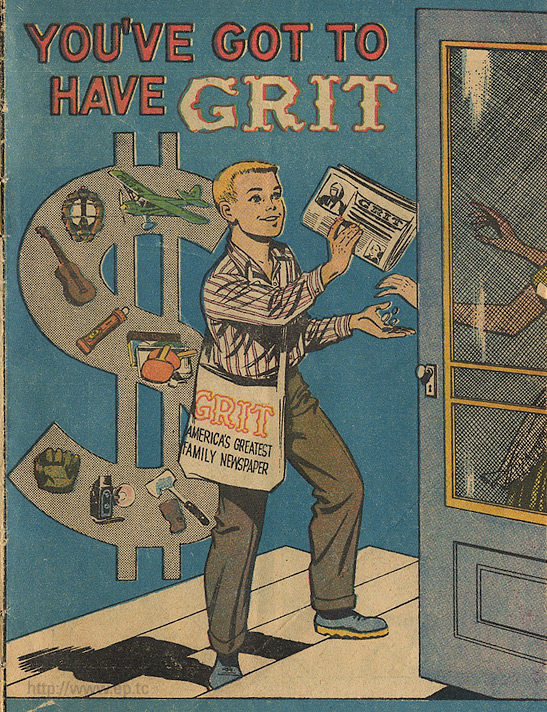
gritA few days ago, I was driving along and I heard an NPR article on the radio. It was about a quality called “grit” and how important it is to cultivate this quality in children.

The notion of grit, which was originally coined for the John Wayne movie, True Grit, been defined by researchers as a character trait involving resilience and determination against all odds. It’s a quality that has been slowly bred out of recent generations, in favor of a cultural emphasis on nurturing a sense of specialness (for lack of a better word) in children.

The formalization of research into “grit” is a clear backlash against the increasingly obvious inadequacies of helicopter parenting. The generation currently entering the work force is entirely unprepared for the realities of the adult world, i.e.: things are not always easy; you are *not* entitled to special treatment; indeed, you are *not* special, (at least, you are no more special than the next person). In short, this generation lacks grit – that special something that causes a person to dig in their heels, take responsibility and overcome obstacles. It’s a stereotypically American trait, and the reality is that many younger Americans have never had the chance to develop it.

And that’s what I find curious. The article outlined various school programs designed to “teach” grit. I’m not actually certain it’s something that can be taught. I am, however, fairly certain that it’s something that can be cultivated.  The notion of grit comes down to determination in the face of challenge. The development of this quality hinges on the habituation of an impulse – the impulse to overcome. As such, allowing children to struggle a bit, to be challenged, to figure things out for themselves, teaches two things:

1. The first is that a person’s worth is not in how much they win, but rather in how hard and how well they fight. How much do you want that passing grade? That place on the team? That skill in dance, or music or art? How hard are you willing to work? If you work the like devil, and don’t get what you want, do you want it badly enough to get back up and go for it again?

2. The second is that the world needs to be actively engaged. One of the side-effects of helicopter parenting is that the child never learns to engage the world for themselves. They learn to sit passively by while their parents engage for them, i.e.: their parents talk to their teachers; their parents do their projects; their parents talk them on to the team. No where in there does a child learn to advocate for themselves.

The cultivation of determination and resilience, (i.e.: grit), empowers young people. It teaches them not only that they have a voice, but that they can use it. This isn’t to say that they will always win, but they will have engaged.

The bottom line, to my way of thinking, is that grit is a fundamentally important quality. It feeds ambition, and determination, and by extension, success. Beyond any external measure, it also informs how you engage the world, and how you conduct your life. As such, I’m pleased to see an emphasis being placed, once more, on it’s cultivation. I’m just sad that it’s fallen so far by the wayside that special programs need to be instated to ensure that grit sneaks back into our culture.

Border Patrol

Big Ben through barbed wire c. 1945

This began as a post about Russia and what’s happening in Crimea, but I’m a little embarrassed to admit that it rapidly became a bit of a self-centered musing about myself. What’s happening in the Crimean Peninsula right now is legitimately interesting, as is the West’s response, (or lack thereof). Apparently, however, it’s not as interesting to me as myself. For this, I apologize. And yet, I forge on….

Recently, I’ve been thinking about boundaries, specifically my own, and how they are both uncompromising and quite flexible – though not universally so.

I’ve always been aware that I have some pretty serious boundaries, which I tend to defend with equal seriousness . In fact, someone very close to me refers to this tendency as my “border patrol”, calling to mind barbed wire fences and armed guards patrolling with guns and large dogs. And as much as I’d like for this to not be the case, it really is true. I have a border patrol and they are always on guard. The black and white bottom line is that some people naturally skirt the barbed wire fence and find themselves inside, while others don’t and are relegated to some portion of the perimeter… some quite close, other’s very far away.

The mechanism by which a person gets past my border patrol used to be a bit of a mystery to me. Most of the time, it happens quite quickly, though not very often – which is why I have a lovely handful of extremely close friends, (most of whom slipped through immediately), and a nice, healthy number of good, friendly acquaintances with whom I enjoy varying degrees of emotional intimacy.

So, there are the people who slip right through the perimeter, and the people with access cards who come and go fairly freely. Call is chemistry or affinity or sympathy or connection, but something between that person and I subconsciously sorts out where they end up in relation to my boundaries. The only thing I know for certain is that the people who sense my perimeters and respect them, are the people who tend to slip through.

Now, the people who really fascinate me are the ones who occupy a strange middle ground. While they don’t kick me into full alert, they inspire a serious, immovable guardedness in me – a sort of instinctive distrust that often translates to dislike.

When full alert happens, I don’t tend to care why. I generally run on the instinct that the person is a psychopath or some sort of son-of-a-bitch and keep them at arms length. Sure, it’s reactionary, but better safe than sorry. The grey area people are different though. It’s not psychopathy or son-of-a-bitchness that I’m cuing to with them. It’s an inherent lack of respect – for my boundaries, in general, and, therefore, for me.

Awhile back, I wrote a post on dominance, or rather, on women and submission. I think that, buried beneath my rabid hierarchical awareness, is the issue of boundaries and respect. I respect other people’s boundaries, and I have an absolute antipathy for people who try to test mine.

This very well may mean that I can’t take a joke, or that I take myself too seriously, but it’s always been the case. At this point in my life, it’s a fundamental part of my personality. So, I suppose that my border patrol is, more than anything, a response – one that can be supple and flexible or cold and hard – and that response, while being an accurate reflection of me, is also a reflection of how I perceive others. While it’s not a perfect lens, it’s the only one I’ve got. The least I can do is understand how it works. I want to be sure that I’m the one paying the guards.

On Food & Love

To say that we, as a society, are conflicted about food, is to understate the depth of our cultural neurosis regarding caloric consumption. We are a nation that openly fat-shames pregnant women while stuffing our faces with Oreos. And yet, our relationship to food wasn’t always so conflicted. For centuries, when lentils were daily fare and a lord’s feast was very much like a family dinner at Buca di Beppo, food was a glory in it’s basic goodness.

My grandmother was born in Spain and escaped during the Spanish Civil War. In the years leading up to Franco’s regime, she knew what it was to be hungry. Decades later, safe and successful in the United States, she still remembered the profound, human anxiety hunger produces, so when her grandchildren came along, she devoted herself to showing us that she loved us in the most critical way she knew. She fed us.

For my grandmother, food was love. If you loved someone, you fed them, because nothing is more basic than ensuring that someone you love has enough food to survive – it doesn’t matter if that survival is literal, as in “here are some berries to tide you over while you hunt that mammoth”, or figurative as in, “you get cranky mid-morning so have a cracker.” To her credit, my grandmother, though a complicated woman, never failed to make me feel loved, and she did so, in great part, through food.

In diametrical opposition to my very modern fears of getting fat, my grandmother felt that if you had so much food that gaining weight was a worry, then you were doing something right. It’s a viewpoint she shared with many people in her generation – a generation comprised of people who had survived World Wars, the Depression, drought, famine and civil unrest, depending on where they had come from. The nation, at that point, was united by the memory of a common experience – hunger, worry and need.

Today, in the wake of a recession that still, in many parts of the country, feels as if it’s going strong, when people have lost jobs and food stamp usage is high despite budget cuts, this type of hunger and worry are all too common. But it’s common on an individual level. There is a divide between the have and have-not’s in this country and that divide is partially responsible for our conflicted relationship, culturally speaking, with food. We are no longer united under the common experience of lean times, as our grandparents were. And so, while there are many (too many) people experiencing hunger on a daily basis in the States, as a country we’re still high on the hog.

So where are we left us as a culture when food is, generally speaking, abundant enough for us to waste, but healthy food the province of those who can afford it? I’m not entirely sure. Without a large-scale catastrophe uniting us in one common experience, our 21st century relationship to food remains complicated. We want to indulge and lose weight, and the stress of that dichotomy has imbued the topics of food and eating with a very different kind of stress than that our grandparents experienced.

The time may have come for us to change the terms by which we think of food. It is, after all, a necessity that crosses all ideologies and all biologies. While I appreciate my grandmother’s point of view, I cannot embrace the notion that food equates love. It is, however, a powerful way to communicate good will, affection, caring and kindness. It’s a way to build community and take care of others. Food is nourishment for our bodies, and a means by which to nourish our relationships, as well.

So, in this month of tortured indulgence, I propose this. That we do not indulge ourselves with despairing abandon, should we have the luxury of doing so, but rather that we share our food with each other freely; that we accept it with gratitude; that we enjoy it wholeheartedly; and that we eat it in a spirit of thankfulness, and yes, of love.