Books, or My Fetish

A two story gallery of books in the old library at Trinity College Dublin for Books, My Fetish by Malin James

Old Library, Trinity College, Dublin

So, let’s play a game. When I say fetish, you say…

SEX!!!

Probably. Or possible not, but for the sake of argument, let’s assume you say, SEX!! Most people, including myself, do. After all, in Western popular culture, fetish really does = sex.

And why not? There are plenty of fabulous sexual fetishes out there – feet, hands, pain, exhibitionism, voyeurism.. hell, there’s even an eyeball-licking fetish.

But not all fetishes are strictly sexual. In fact, traditionally speaking, (and by traditional I mean dating back to the early 17th century), fetishes were spiritual in nature, and were almost always objects worshipped for their supposed magical powers. If you go by the original meaning, anything from a voodoo doll to a saint’s relic is a fetish – an object used or revered for it’s spiritual power.

This made me realize something. I have a book fetish – a serious, committed, barely-restrained book fetish.

It isn’t that I literally worship books because I think they’re literally magical. It’s more that, for me, books have an inherent value and, because of that, they are the locus of my compulsion to acquire new things. In other words, some people have shoes, other people have exes, and I have books.

Nigella Lawson's private library. Image courtesy bookmania.me

Nigella Lawson’s private library. Image courtesy bookmania.me

Since I was old enough to buy my first Nancy Drew with my very own money, I have surrounded myself with books. I buy, borrow, give, and receive books with a pure, transactional joy that should be acquisitive but isn’t. Really, I just love books. I love stacking them, collecting them, rearranging and classifying them. I love holding them and writing in their margins, and of course, I love reading them.  The book, as an object, is comforting to me. It doesn’t matter if I’ve read it five times or never heard of it, books are totems. They are, quite literally, a mental escape hatch, and in that way they are an incredibly significant part of my personal growth.

I can trace my development as a person back through my reading material, from Laura Ingall Wilder’s Little House books to A.S. Byatt, Dorothy Parker and Anais Nin. Each phase in my reading reflects an emotional phase in my life, and the books that I read during those phases are, in essence, relics of the person I was. My books are a map of my past, and an indicator of future interests and selves. So yes, I have a old-fashioned fetish. I attach spiritual significance to books. I will never read every book I own, and I will never own enough… That doesn’t mean I’m not going to try.
 

Defining Literature

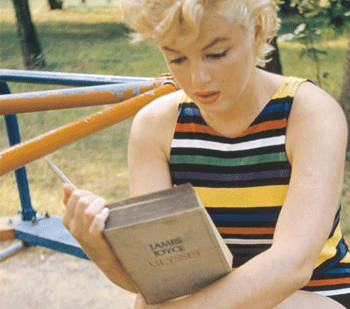
Marilyn Monroe reading Ulysses. Cover image for James Joyce: A Critical Guide, image for Defining Literature post by Malin James

Marilyn Monroe reading Ulysses. Cover image for James Joyce: A Critical Guide

Tuesday was April 1st, which means that no one on the internet could be trusted, including Sparky Sweets, PhD., one of the awesome minds behind Thug Notes, a weekly series on YouTube in which Dr. Sweets systematically breaks down the Western Canon, 4 minutes at a time, in a gangsta version of Cliff’s Notes.

At some point, I’m going to do a post on why I love Thug Notes, because the show is doing something incredibly important, but for today I’m going to focus on Tuesday’s installment – Summary and Analysis for Stephanie Meyers’ Twilight… APRIL FOOL’S! It was actually Huck Finn masquerading as Twilight. I laughed my ass off – they got me 🙂

Anyway, a friend posted the link to my Facebook wall and there followed a short thread in which people enjoyed the joke. One commenter also mentioned that it’s important to get kids to read “real literature”, (I’m paraphrasing). The thread ended when another commenter posted that she had greatly enjoyed the Twilight series, and felt that the definition of “literature” is “in the eye of the reader.” This, of course, got me to thinking..

This small disagreement points to a larger scale dispute in Western publishing, education and culture. Why do people read? Are certain books more valuable than others? How, in fact, should we define “literature”?

While I don’t think that the definition of literature is in the eye of the beholder, I do think that the value of a book is. The commenter who had enjoyed Twilight did something that is perfectly reasonable – she enjoyed Twilight. That series was not designed with any greater purpose than to be enjoyed. As a result, it’s value lies in how well the reader enjoys it. This reader enjoyed it a great deal, so Twilight is legitimately valuable to her – just as valuable as Anna Karenina or Huck Finn is to someone else.

The value placed on a book is personal, and it has to do with two things – the reader and the book’s intended purpose. The Firm, Cuckoo’s Calling and the entire Danielle Steel catalog were written to be enjoyed and consumed, and there is great value in that. Vehicles for escapism are, actually, valuable. It does not, however, make them literature, and here’s why:

Literature is a specific kind of fiction. Literature can, and often does, entertain, but it has a twin purpose –  to examine something in some way. This examination can be anything from the American dream (The Great Gatsby) to the nature of sexual submission, (The Story of O). Literature doesn’t want you to escape, it wants you to engage, and therein lies the difference.

The problem comes when people assign judgements to these two different purposes by devaluing a fun read, like Twilight, while falsely elevating “literature”, like Ulysses. In fact, what I like about Thug Notes is that it topples the ivory tower that literature is placed on so often – literature can, and should, be enjoyed. It just also asks you to think, or analyze, or ponder, or consider.

If you’d prefer to get lost in a story and escape, read an awesome book – that’s great. If you prefer cultural commentary with your enjoyment, read literature. Better yet, read both. Enjoy both. And find the value in both. Really, when it comes down to it, just read. That’s the most important thing.

Grit

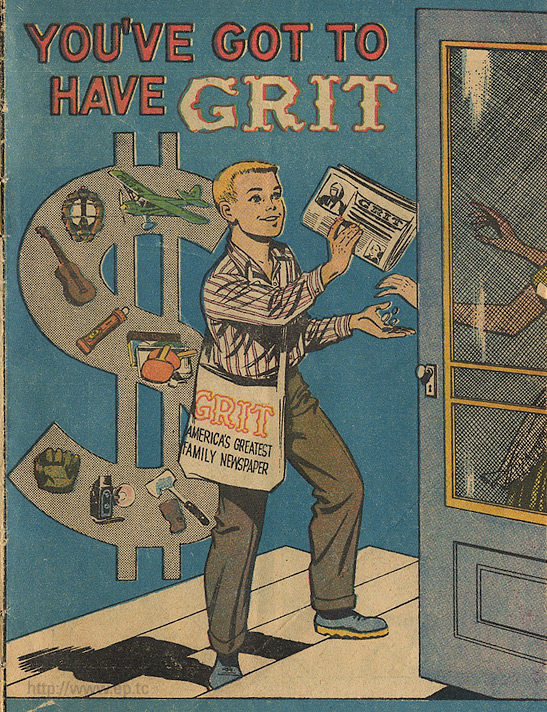
gritA few days ago, I was driving along and I heard an NPR article on the radio. It was about a quality called “grit” and how important it is to cultivate this quality in children.

The notion of grit, which was originally coined for the John Wayne movie, True Grit, been defined by researchers as a character trait involving resilience and determination against all odds. It’s a quality that has been slowly bred out of recent generations, in favor of a cultural emphasis on nurturing a sense of specialness (for lack of a better word) in children.

The formalization of research into “grit” is a clear backlash against the increasingly obvious inadequacies of helicopter parenting. The generation currently entering the work force is entirely unprepared for the realities of the adult world, i.e.: things are not always easy; you are *not* entitled to special treatment; indeed, you are *not* special, (at least, you are no more special than the next person). In short, this generation lacks grit – that special something that causes a person to dig in their heels, take responsibility and overcome obstacles. It’s a stereotypically American trait, and the reality is that many younger Americans have never had the chance to develop it.

And that’s what I find curious. The article outlined various school programs designed to “teach” grit. I’m not actually certain it’s something that can be taught. I am, however, fairly certain that it’s something that can be cultivated.  The notion of grit comes down to determination in the face of challenge. The development of this quality hinges on the habituation of an impulse – the impulse to overcome. As such, allowing children to struggle a bit, to be challenged, to figure things out for themselves, teaches two things:

1. The first is that a person’s worth is not in how much they win, but rather in how hard and how well they fight. How much do you want that passing grade? That place on the team? That skill in dance, or music or art? How hard are you willing to work? If you work the like devil, and don’t get what you want, do you want it badly enough to get back up and go for it again?

2. The second is that the world needs to be actively engaged. One of the side-effects of helicopter parenting is that the child never learns to engage the world for themselves. They learn to sit passively by while their parents engage for them, i.e.: their parents talk to their teachers; their parents do their projects; their parents talk them on to the team. No where in there does a child learn to advocate for themselves.

The cultivation of determination and resilience, (i.e.: grit), empowers young people. It teaches them not only that they have a voice, but that they can use it. This isn’t to say that they will always win, but they will have engaged.

The bottom line, to my way of thinking, is that grit is a fundamentally important quality. It feeds ambition, and determination, and by extension, success. Beyond any external measure, it also informs how you engage the world, and how you conduct your life. As such, I’m pleased to see an emphasis being placed, once more, on it’s cultivation. I’m just sad that it’s fallen so far by the wayside that special programs need to be instated to ensure that grit sneaks back into our culture.

Barnard on Feminism in the 21st Century

Recently, a representative of Barnard College reached out to me with the details of a new initiative that explores what it is to be a feminist in the 21st century. How do young women engage the notion of feminism in art, ideas and activism now? In an effort to explore this question and many others, Barnard College is beginning a new podcast called, Dare to Say the F-Word. In it, issues from identity and perfectionism to why many young women today hesitate to identify as “feminist” will be explored.

At a time when there is so much contention over what the word “feminist” even means, I think this sort of initiative is incredibly valuable, if only as a means to explore, and possibly even attempt to redefine, the word for a new generation.

Rather than go on at length, however, I’m going to provide a link to post written by Barnard President Debora Spar, author of Wonder Women: Sex, Power & the Quest for Perfection. In it, she explains that while many women today struggle with the idea of perfection, they also struggle with the concept of feminism itself, which is one of the many issues that will be addressed in Barnard’s new podcast, Dare to Say the F-Word, which I mentioned above. Here’s the link:

Read President Spar’s thoughts in this exclusive post.

While I have my own thoughts on what feminism is and how it functions (or fails) to now, I am personally, very heartened by any effort to explore an ideological issue from a discourse-driven point of view, and it seems to me that Barnard is attempting to engage feminism from just such a place. As a result, I applaud their efforts and very much look forward to seeing what comes of it.


On Over-Education, or The Economics of Thought

Education in the U.S. is a political topic, I want to focus on the individual’s relationship to education – specifically higher education and the pursuit of advanced degrees – and because I’m the individual that I know best, I’m going to look at this through a fairly personal lens.

As a caveat, I just want to state that I realize that I’m coming at this from a financially privileged place.

I have two advanced degrees, neither of which has led to my chosen career. Master’s degrees are costly, and mine are no different. The price is paid in time and effort, in the wobbling balance between work and life, and in so much money

I chose to pay these costs, not once but twice, and I take responsibility for those choices. But given the costs that I chose to pay, I would have expected the lack of concrete returns to distress me. And there are days when it does – deeply.

It would have been nice to see a career rise directly out of the educational foundation I laid. After all, the age of the gentleman scholar is over, and though I am no gentleman, I have scholarly predilections and a fair amount of training in that regard, which is why I can’t fully commit to bitterness at the lack of tangible returns. Although I’m distressed by the broken promise, economically speaking, of higher education, I did not come away from these degrees empty handed. Far from it.

In exchange for my time and money, I acquired the ability to analyze and critique, to research, to write critically, to communicate clearly, to document and to argue a point. I strengthened my natural tendency to wonder and find out. In short, I learned to think for myself, because while I was deciding that Derrida was a fraud and post-modernism a house of cards, while I was learning that cataloguing and classification have become ironically complicated, given their original purpose was to simplify the storage of knowledge, I was exercising the muscle of analytical dispassion. There is an intense amount of value in that, though the cost is high.

Would I have chosen to undertake two advanced degrees had I known that the gains would be of the intangible, personal sort? No. I would not. But I’m grateful that I did. My degrees haven’t yielded conventional goods, but they have brought me to a better, more thoughtful self. It’s a luxury I didn’t intend, but one I’m lucky to have had.

What Are We Saying When We Talk About Sex, Religion and Politics?

In honor of the holidays, I’d like to take a look at the three topics of conversation that everyone knows to avoid at social gatherings.

Sex. Religion. Politics.

To put it mildly, this triumvirate  can be divisive, which is why they’re famously avoided in favor of awkward small talk and coversations that no one wants to have. Sex, religion and politics are naturally controversial – unless all of the conversationalists agree. If the majority of people in the room hold them same beliefs, then these issues become a way to bond and confirm one’s acceptance in the ideological fold. The ideology itself is secondary to re-affirming a sense of belonging; or, to put it another way, it is the conduit through which this re-affirmation is performed. This is a pretty universal phenomena – doesn’t matter if the ideology is Christian nationalism, atheism, queerness or Catholic Pro-Choice Buddhist Libertarianism…. The downside to this bonding experience is the formation media silos that get consistently and thoughtlessly. People with differing beliefs are “othered” more and more.

There’s a contrarian impulse to  bring up trans-athletes when we know that Aunt Janice is a TERF? Why talk about what a goon Nick Fuentes is in from of Uncle Ed, who thinks that “Hitler took a good idea too far”? Is it just an impulse to troll?  Or is there something deeper functioning?

I suspect that it comes down to a couple of things. The first is biology – it literally feels good to throw down ideological grounds. Righteousness = dopamine. The second is evolutionary and a little more complicated. Riling up your vegan cousin or your MAGA neighbor is a little bit like defending your thought village from hostile invaders.

This is not to say that ideologies are bad. I’m full of ideologies, as are most human beings. To believe in things is incredibly human, so I will not fault humans for having beliefs. The trouble isn’t in ideologies, but in the bubbles around them, ie: our inability to see past our own to consider the views of others.

When sex, religion or politics are brought up in the context of extended families, roasted meats and lots of alcohol, the impulse might be ideological, either as an assertion of our own ideology, and the deep-rooted need to have that identity ratified by non-believers. Or, to put it more simply, to change Aunt Janice’s goddamned mind. This is clearly not going to happen because she feels the same way about you. But we have the impulse to try.

This impulse is important, because it’s an impulse to engage. While ideological clashes can, and often do, lead to uncomfortable interactions, they also open the door to possible engagement if the participants are willing to approach each other flexibly.

Sex, politics and religion are divisive issues. Discussing them is not always useful or healthy, but their divisiveness also contains an impulse to engage. That is where their potential lies, but their value lies in going one step farther, past simple engagement, to a place of thinking and of discourse as we challenge and are challenged. This feels impossible right now, but I’m hopeful.