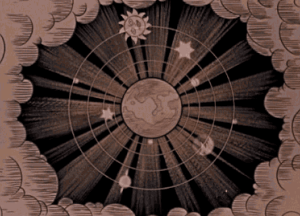
Earth at the Center of It All
Today is the funeral of Alton Sterling, the man who was (senselessly and illegally) killed by Baton Rouge police last week. Yesterday, a man drove a semi-truck full of weapons into an unarmed crowd in Nice, killing at least 80 and probably more. Last month, Omar Mateen shot and killed 49 people at an Orlando nightclub.
These are hardly isolated incidents. We know that, as individual tragedies, they represent thousands of under-reported human tragedies. Or, if you want to get really nasty, they highlight the violence that we have leveled at each other for millennia.
Maybe this knowledge – that tragedies are common and always have been – underpins the impulse to say, (with every intention of giving or taking comfort), that “everything happens for a reason.” As a well-meaning response to tragedy, either personal or global, it acts in a dual role of bromide and organizing principle – take comfort. Nothing so awful as miscarriage, police brutality, or suicide could be senselessly wrought. Your suffering cannot be senseless. There is a bright side to look on.
The idea equivalent of a hug after a nightmare. I almost wish I believed it.
For me – a person who has never believed in the Judeo-Christian God, or in universal answers of any kind, it feels like a lie, and I can’t bring myself to trust it.
Before I go on, I want to make it clear that I’m talking about my own world view here. A lot of humanity believes that everything does happen for a reason, just as a lot of humanity believes in a God. We all engage life in individually determined ways (…which my ultimate point, but I’ll get to that). My atheist / Buddhist worldview works for me, but if you believe that everything happens for a reason that’s cool too. I’m not interested in challenging (or judging) your belief. I’m just expressing why I don’t share it.
Over the course of my life, some bad things have happened. When I was younger, I struggled with the why of it. I clung to the idea that everything must happen for a reason because I couldn’t bear the idea that my hurt was for nothing. Then I read an interview Keanu Reeves did after his girlfriend died 18 months after giving birth to their stillborn daughter. You could feel the interviewer trying to figure out how to address the almost embarrassing amount of personal tragedy Reeves had just sustained.
As part of the interview she asked him if he believed that everything happens for a reason. And Reeves, very calmly, said, “No. I believe everything happens.”
Suddenly, my attachment to the idea of a cosmic rationale dropped. Because yes. Everything happens whether it’s justified or not. You cannot assume there is justification (or even a meaning) for unbearable things. When we say “everything happens for a reason” is a plea – “please tell me it’s not for nothing.”
Keanu Reeves’ girlfriend died because she lost control of her car. She did not die so he could become a better Buddhist (or actor, or activist). His response was self-determined. If he became a better [fill in the blank], it’s because he chose to, not because her death was meant to be.
Likewise, bad things happened to me because someone decided to do them. Not because it would make me the person that I am. My self-determined response helped make me who I am, but it does not give cosmic meaning to, or justify, the events that cauterized me.
God does not open a window when he closes a door. There are no windows and there are no doors. There is no fucking house. There is only what we do – to and for each other, as well as in response to horrible things that happen. Because things do happen because something prompts them – ‘reason’ as part of cause and effect, rather ‘reason’ as higher cause. Let’s take Nice.
Nice happened because a man decided to attack an unarmed crowd. It was a random and violent example of one man imposing his will on the lives of innocent people. Those people were acted upon in a terrible, tragic way. They had no control. They were victims of a cause and effect without ever knowing. Now, in the aftermath, the survivors and family members will respond. Their responses are self-determined reactions to the individual effects of a massive tragedy. Some will find ways to a positive personal outcome. Others won’t.
I know that my emphasis on self-determination rather than on faith in a higher power may read as flimsy to those who believe in determinism. From that point of view, it would be easy to read this and say, “Ah, but what if your “self-determined” response is just part of the plan? What if the horrible things that happened did so to get you to this pre-determined point?”
Honestly, I can’t answer that because from the point of view of having and protecting a belief, that makes total sense. I just don’t have that point of view. The way I’ve experienced it, I respond based on a deeply personal, internal calculus that is largely instinctual. I have no faith to put my trust in, so I am forced to trust myself. This is, I must emphasize, not easy because what the hell do I know?
For me, we are all individual actors responding to cause and effect phenomena that defy justification. If you find comfort in the idea that everything is pre-determined, then take that comfort. Take what comfort you can get.








 Madeleine James