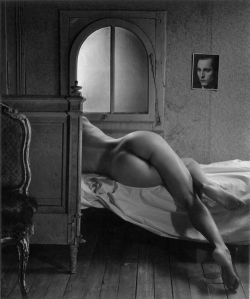
I write erotica under a pseudonym. Many authors writing in this genre do. It wasn’t until recently that I considered why that might be.
When I first started writing erotica, I took a pseudonym for two reasons. The first was down right frivolous – I thought it might be fun. The second, and far more practical reason, was that I freelance in a number of different markets and the pseudonym would allow me to keep the two halves of my writing career separate.
I suspect that, for the majority of authors, the use of a pseudonym is equally practical. Many writers have primary careers that would be negatively affected if the sexual nature of their writing were to become known. People expect their teachers, therapists, and doctors to be morally squeaky clean. Patients do not want their gynecologists to write erotica on the side. Erotica, though mainstreaming, is not yet above reproach.
In addition, the moral / ethical concerns mentioned above can, at times, extend themselves into an author’s private life, particularly when the writer’s parents, children or partner might be negatively affected. No teen-age boy wants his friends to know that his mom “writes porn,” and a father’s custody could be contested if his career as an eroticist were brought to light in court. As a result, it’s easier for many erotica writer to allow the nature of their work to remain selectively ambiguous. Ours is not a widely respected genre, after all.
There is a lot to say about the stigma associated with reading and writing erotica, a genre that is, for many, still negatively associated with historically pejorative terms like “porn”, “smut”, and “dirty story.” Despite the fact that these labels are being slowly reclaimed by those who read and write in the genre, the stigma still remains. There is quite a lot to say about why this might still be true, but I will resist the impulse to digress and, instead, focus on one, specific point, and that is how my pseudonym – the ubiquitous accessory of pornographers, eroticists and writers of dirty stories everywhere – has come to function for me.
Allow me to begin with what my pseudonym is not.
My pseudonym is not an apology for what I do. It is not a way to distance myself from what I write. I am proud of my work in this genre, and I am equally proud to be part of a community of writers that displays a level of causal curiosity that is admirable in an openly cynical age.
What my pseudonym is, is two different things. It is an invitation and a boundary; it is a welcome and a wall. It provides me with an identity that can be publicly shared, while remaining separate from my own. It gives me a persona to extend to my readers, while allowing me to both maintain, and transcend, the public / private divide.
Invitation. Wall.
Why, as a writer, would I need such a thing?
Because when you write about sex, particularly intentionally arousing, fictional sex, people react, often more viscerally than they would to content that is not quite so sexually explicit. My pseudonym invites the reader (or public) to engage and connect with my work, while allowing my non-public self a certain degree of anonymous privacy.
There is a long-standing assumption about writers. The assumption is that, however unlikely, an author’s work must be, in some way, autobiographical. In my experience, this assumption is heightened with eroticists. After all, our work is inherently sexual and very often kinky, edgy or taboo. We write sexual fantasies with the express purpose of arousing the people who read them. Because of this, the perceived intimacy of autobiography, when it arises, can be particularly intense.
For most readers, this perception of intimacy is not an issue. They read a story, they enjoy the story, they move on to the next story. There is, however, a small minority of readers who crave access to the writer beyond the limits of the page. They want the personal connection they made with a story to extend to the author who wrote it.
Some time ago, a reader contacted me in a manner that can only be described as overly attached and profoundly curious. This reader had connected, romantically and sexually, to a story that I had written and published under my pseudonym. He confessed that he wished to gain deeper, truer access to the woman who had written it; he wanted to share my mind and, somewhat chillingly, my “soul”. This reader, caught in the illusion of sexual intimacy that the story had created, wanted exclusive access, not to what I had written, but to me.
What’s more, this gentleman had constructed around my work and pseudonym, a persona that he desperately wanted to believe in – that of the sophisticated vixen and dominant mistress who would grant privileged access only to him. It was a fantasy that he’d spun with no input or encouragement from me, save for the story that I’d written and that he, in turn, had read. This is when my pseudonym became more than a pithy solution to a professional problem. This is when it became a wall. It gave this man something to attach to, without attaching dangerously to me. It gave me the space I needed to diplomatically end his fascination. And so, we were both able to moved on.
Interestingly, this has never happened with any of the essays, articles and reviews that I’ve written under my own name. Nonfiction has never elicited this kind of intensely personal response, though there is far more of me on display in that work than in the fantasies I spin.
Why is this? What is it about erotica and erotic fiction that has the power to inspire such an emotional, sexual and even psychological attachment? Why the need to possess?
I believe it comes down to connection. People crave connection. We want the exclusivity of understanding. We desperately need to be understood. It’s shockingly erotic to be understood, (to paraphrase Mary Rakow). So, when a story resonates with a reader, that resonance can, at times, go beyond the page to creates the illusion of kinship, sympathy and intimate understanding; and that illusion can be a very intense, indeed.
The strength, as well as the challenge, of public / private divide as regards writers and readers, is that the reader gets access only to what the writer allows. Only the writer herself knows the degree to which her mind, soul, psyche or heart appears in her work, and she is under no obligation to say. Because of this, the publication of a piece can be seen as a sort of offering. It is an author’s consent to grant public access to whatever appears, both explicitly and implicitly, in her text. This does not, however, equate to full, private access to her.
When someone reads my work, I want the focus to be on the work, not on whether I am, personally, gay, straight, bi, kinky, vanilla, submissive or dominant. I don’t want my life and predilections to muddy the ink on the page. That ink represents the access that I grant. My pseudonym, and the persona it names, invites the reader to enjoy my work without the distraction of injecting me into it. Just as importantly, it gives the reader a safe avatar to attach to, if only until they move on to the next story.
Authors want desperately to connect with readers. We want our work to be enjoyed and understood. For me, the public / private divide allows me the security and the freedom to pour words, uninhibited, onto the page and strive to make that connection. It frees me up to engage and explore and write with far more abandon, and honesty than I otherwise might. My pseudonym allows me to walk the delicate line between my private and public selves. I could never have predicted the depth of my relationship to my pseudonym, my lark of a second-name, but I am profoundly grateful for it now.

 Madeleine James