On Depression and the Value of Contentment

There is a photo of me from when I was about three years old. I wish I knew where the was, but it’s fallen into the void of my mom’s house. In the photo, I am wearing my “polka-dotty dress” which is white with tiny red polka dots and a red ribbon around the waist. It is my favorite dress and I feel extremely sassy in it. I have my dimpled hands on my hips and I’m grinning down at the camera from the top step of a porch. The sun halos me from behind, soft and orange in early eighties Kodachrome, but it’s my smile that Iights the image up. This is the last visual image I have of myself as a fundamentally happy person.

When I say “happy person”, I don’t mean “happy” in a situational or contextual sense. I have been happy many times in my life, and I have many happy memories to go with them. Wide-ranging conversations make me happy.  Reading a book on a rainy day makes me happy. My daughter’s grin makes my heart burst with happy. Infusing honey with lavender before the house wakes up makes me happy. The happiness that I feel in these moments is real, but it’s also contextual, not fundamental to me as a person.

I was happy because something made me happy. Happiness as a result of an external influence, not an integrated state of being. They exist like flashes in the brain pan of my day,  pulling me up out of a naturally neutral state. It’s not that I walk around unhappy – it’s more that  my resting state is  grave, depressed in the literal and clinical sense.

I am a depressive, but I am not anhedonic . I feel pleasure. I feel happiness. But neither are consistent or independent of external influence. Contentment is. I am, if not happy,  profoundly content.

For young me, “contentment” was the opposite of “really living”. It meant that you had settled, and I was not going to settle. I was going to blow out my emotional credit limit and pay the bill in my thirties.  Paying the bill was rough – necessary but rough. Five years of therapy later, I am modulated and mindful and wildly functional. I am also gratefully content. Ironically, contentment is, for me, its own kind of joy. It’s not the champagne of pure happiness. Rather, it’s the mulled wine of a hard won stability, which makes me very happy.

It’s lovely to feel that my life is good and complete. While contentment doesn’t eradicate the need for ongoing effort (some struggles have deep roots), but I feel myself to be in balance. My contentment is as fundamental to me as my gravity and neutrality. The scale still tips one way and the other, but it returns to it’s baseline, which is a strange and happy thing.

*Side Note:  I should explicitly state that what I’m describing isn’t the difference between being depressed or not depressed. Depression isn’t as simple as happy vs. sad, nor is depression synonymous with sadness, as any depressed person can tell you.
On Dialogue

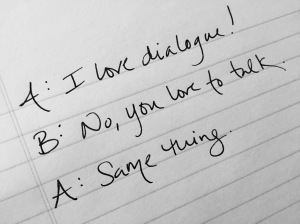
Black and white picture of handwritten dialogue by Malin JamesI posted a story on my other site yesterday that reminded me how much I love writing dialogue. A lot of my stories are fairly minimalistic, with people saying less than they strictly have to. It’s as much about what’s happening in the gaps as it is about what’s being said.

But yesterday’s story was the opposite – nearly all dialogue, driven by a comfortable, natural patter between two sisters. It was an off-the-cuff thing and it felt great. It also reinforced something that I’ve always known about myself as a writer – that my writing is informed by acting in all kinds of subtle ways.

I have no formal training as a writer. I taught myself how to deconstruct and write stories over the course of twenty years, two Master’s Degrees and lots and lots of books – good books, bad books and books I can’t even remember having read. What I do have is extensive acting training and experience working with characters on stage.

Which is why so much of my writing is character driven. There’s always a plot (because without plot, it’s a moment, not a story), but the plots are almost always fueled by a character’s internal drives and motivations, rather than external forces. This will likely change at some point because a person’s writing is almost never fixed. Like aspects of any other creative discipline, a writer’s style and voice tend to evolve over time (so long as the writer lets them).

What I don’t imagine changing is that I will always be primarily interested in the people I’m writing about, (as opposed to concepts etc). Because for me they are people – not little objects I’ve constructed – so it’s natural for me to want get into their heads and dig around. That’s where all the acting comes in handy. I analyzed and interpreted other people’s characters, from Shakespeare to Chekov, for years, so playing with my own characters is like working in a mental playground. And a natural extension of that is writing dialogue.

No one sounds the same. Even two people, raised in the same household, in the same place with all of the same frames of reference sound different because, in the end, no matter how similar they are, they are two different people. Ask any set of twins. But rather than consciously trying to make the two sisters in yesterday’s story sound different, I let their differences play themselves out.

One sister is sexually experienced and up for anything. The other isn’t so sure. So, how would a conversation about a new boyfriend’s fetish go down, especially if it happened over drinks with a hot bartender listening in?

So, you take your two people and you set them down in a context, and then you just let them talk. I know that sounds ridiculous and kind of woo-woo, but I honestly believe that good dialogue comes from being impulsive, open and trusting your gut.

That’s not necessarily the case with all things in narrative. Plot needs conscious attention because it needs to make sense (unless your Thomas Pynchon, whom I can’t stand). Other elements, however, need your conscious attention to get out of the way so your subconscious attention can go to town.

characters have an agenda because your brain has a story to tell, and sometimes you’re only 10% aware of what that story actually is. The characters are the subconscious dynamos that drive whatever that story is, so when you write dialogue without trying to consciously mold it, you’re allowing your brain to tell you the story in the voices of the characters who inhabit it.

Good dialogue isn’t “dialogue” at all. It’s a conversation. All you need is a (really) basic understanding of who’s talking, why and where, and you’re off. Sometimes nothing comes of it, but sometimes something does, and when it does, when your characters surprise you by sounding like people, not like extensions of yourself, you know you’ve written dialogue that works.

I know this sort of approach isn’t right for everyone because every writer is different. I write to find out what I’m trying to say so an instinctive approach to dialogue is natural for me. For writers who work in a more structured fashion, what I just described would probably drive them nuts. The bottom line is that, no matter how you work, dialogue should slip into the reader’s head. You want your reader to hear what’s being said, rather than think, “wow, that’s great dialogue!” Acting is just the influence that helps  me get there.