Knee-Jerks, or Elle and the Belle Knox Interview

I was going to post something on gotcha questions and how they are both overrated, (as rhetorical tools), and valuable, (as nudgers of social change). However, I’m putting that aside for a second because I got a distracted by my own annoyance.

Why am I annoyed? Because of an interview. Or, rather,  by certain public responses to an interview.

Yesterday, Elle.com published a bit of very timely journalism. Rachel Kramer Bussel, an editor and journalist with a well-established track record in the area of sex and culture, did an interesting, insightful interview with Belle Knox, “the Duke porn star” who was outed by a fellow student awhile back.

The interview reveals Ms. Knox to be a thoughtful, self-possessed young woman who sees herself neither as a victim of her choices, nor of circumstance. Her grounded lack of entitlement was unexpected in the face of Ms. Bussel’s questions, which were insightful and wide-ranging. Clearly, a great deal of thought went into this piece and what emerged was the portrait of a real young woman, with a brain in her head. But this doesn’t matter. What matters is that she was a porn star. Apparently, this devalues EVERYTHING she might have to say.

Elle.com is in the process of receiving a bit of flak for running an interview with, in the words of one concerned reader, “an over-educated whore.”

So, why am I annoyed? Because of the name-calling? I don’t like it, but no. Because of the stigma placed on a young woman’s sexuality? I really don’t like that, but no there, as well.

The source of my annoyance is the blatant lack of thought displayed by many of the people who have posted negative comments in relation to the article. To put it bluntly, it’s fairly clear that many of them didn’t bother to even read the interview before opining. They just had a knee-jerk reaction and ran with it. Much quicker and easier to skip all that reading and head to the comfort zone of righteousness and outrage.

Righteousness and outrage are emotional drugs. They feel good, especially when we get together with a mob of like-minded people carrying torches and sticks. The quality of the journalism doesn’t matter. What many of the commenters did was see is “Belle Knox”, link it to “whore” and then judge Elle for having the temerity to run a piece of journalism that offends or threatens a particular set of sensibilities.

But here’s the thing. In this case, it seems that it isn’t the interview that offends so much as the fact that it was published at all. When it comes right down to it, this post, (okay, rant), isn’t about Elle, or Belle Knox, or porn. It’s about thinking, and how so many people in our culture just don’t.

So, here’s what I propose. If you don’t want to read something, don’t read it. But keep your thoughts to yourself. Consider reading, (or listening, or watching), to be your ticket to voicing your opinion. If you don’t like the coverage, or the interview, or the film, or the book, or the show, that’s perfectly fine. But know what you’re disagreeing with before you open your mouth. Let it be your disagreement – considered and full of your thoughts – rather than the unthinking disapproval of your demographic, whatever that happens to be. Let your brain off the leash and take it for a nice, long walk. It might feel really good.

Grit

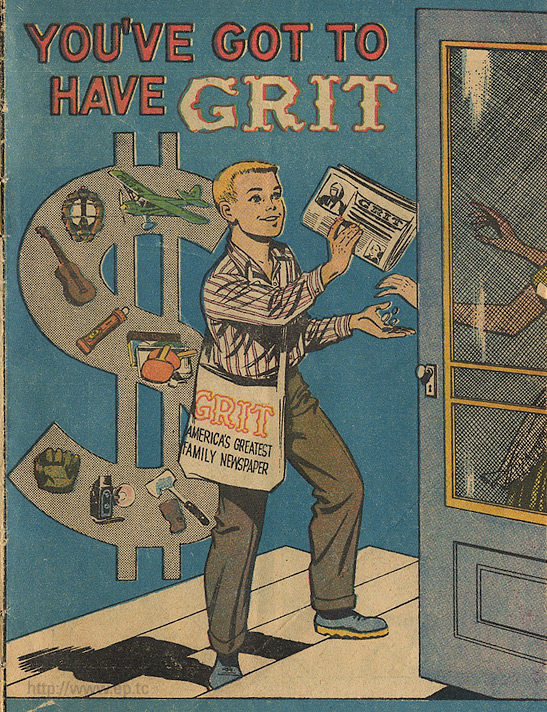
gritA few days ago, I was driving along and I heard an NPR article on the radio. It was about a quality called “grit” and how important it is to cultivate this quality in children.

The notion of grit, which was originally coined for the John Wayne movie, True Grit, been defined by researchers as a character trait involving resilience and determination against all odds. It’s a quality that has been slowly bred out of recent generations, in favor of a cultural emphasis on nurturing a sense of specialness (for lack of a better word) in children.

The formalization of research into “grit” is a clear backlash against the increasingly obvious inadequacies of helicopter parenting. The generation currently entering the work force is entirely unprepared for the realities of the adult world, i.e.: things are not always easy; you are *not* entitled to special treatment; indeed, you are *not* special, (at least, you are no more special than the next person). In short, this generation lacks grit – that special something that causes a person to dig in their heels, take responsibility and overcome obstacles. It’s a stereotypically American trait, and the reality is that many younger Americans have never had the chance to develop it.

And that’s what I find curious. The article outlined various school programs designed to “teach” grit. I’m not actually certain it’s something that can be taught. I am, however, fairly certain that it’s something that can be cultivated.  The notion of grit comes down to determination in the face of challenge. The development of this quality hinges on the habituation of an impulse – the impulse to overcome. As such, allowing children to struggle a bit, to be challenged, to figure things out for themselves, teaches two things:

1. The first is that a person’s worth is not in how much they win, but rather in how hard and how well they fight. How much do you want that passing grade? That place on the team? That skill in dance, or music or art? How hard are you willing to work? If you work the like devil, and don’t get what you want, do you want it badly enough to get back up and go for it again?

2. The second is that the world needs to be actively engaged. One of the side-effects of helicopter parenting is that the child never learns to engage the world for themselves. They learn to sit passively by while their parents engage for them, i.e.: their parents talk to their teachers; their parents do their projects; their parents talk them on to the team. No where in there does a child learn to advocate for themselves.

The cultivation of determination and resilience, (i.e.: grit), empowers young people. It teaches them not only that they have a voice, but that they can use it. This isn’t to say that they will always win, but they will have engaged.

The bottom line, to my way of thinking, is that grit is a fundamentally important quality. It feeds ambition, and determination, and by extension, success. Beyond any external measure, it also informs how you engage the world, and how you conduct your life. As such, I’m pleased to see an emphasis being placed, once more, on it’s cultivation. I’m just sad that it’s fallen so far by the wayside that special programs need to be instated to ensure that grit sneaks back into our culture.

Portrait: Jean the Ambiguous

I love androgyny. I always have – from Marlene Dietrich in a tux to David Bowie in anything – androgyny is beautiful to me. It’s been a while since I posted a bit of fiction, so I dug into the archives, (i.e.: the ancient, dusty files on my hard drive), and unearthed this character study. After a bit of dusting off, I remembered by I’d written it – I rather love Jean. In fact, Jean will very likely end up in a story of Jean’s own. In the meantime, however, here’s a sketch of the fabulous Jean, who defies the constraint of labels and gender. 

Jean the Ambiguous

androgenous jeanOne can only begin to description of Jean by saying that Jean is French. Though Jean’s nationality has little practical bearing on Jean’s personal behavior (aside from a certain pronounced flair), the fact the Jean is French factors into a separate, pivotal, matter—the interpretation of Jean’s name. Or, to put it more succinctly, the choice of pronoun one uses reference to Jean.

You see, the French spelling of “Jean” is not “gender specific,” and neither, really, is Jean. If Jean were only English, (or American in a pinch), the ease of gendered spelling would see one through—“Jean” or “Gene”, “he” or “she.” The question of pronoun would cease to exist.

Ironically, the ambiguity of Jean’s name is a perfect reflection of Jean, which, though prickly to admit, is the root of the difficulty. One must also admit that a contributing factor is Jean’s stubborn (though admittedly suave) insistence on not offering any definitive evidence as to gender in either dress or manner. Allow me to clarify.

Jean is tall and slender – tall for a woman (though not unthinkably so) and quite average for a man. Jean’s hands are fine-boned, with long, rather sensitive looking fingers – Jean has the hands of a fine woman or an accomplished musician. Unfortunately, Jean’s income and fame are entirely due to the virtuosity with which Jean plays the violin, so there is little help there.

That’s all fine and good, you must be thinking, but one can surely tell a person’s gender from his or her manner of dress! In answer to this, I’ll admit that it’s true in most cases. But Jean’s manner of dress is unconventional for either sex—tailored suit with a flared coat; French cuffs and lovely jeweled links; a snowy white shirt with a ruffled front; dramatically high collar; crisply knotted tie. The lacquered longish hair adds to the confusion. Is Jean a woman with short hair, or a man with long? It’s impossible to tell.  The only thing one can say for sure is that Jean’s cologne, (or perfume), smells quite good.

So clothing is no help, and neither is bearing. There is always seduction in the large, smudged eyes; a feline smile on the pale, oval face. One moment, one is sure one has solved the riddle of Jean, only to see the picture change….

And so what is one to do? Ask leading questions? Jean smiles mysteriously, (or negligently or indulgently or flirtatiously), and one is dazzled but no closer to knowing which pronoun to use. And so the mystery continues, adding flame to the fire, and fueling the allure of the obsession that is Jean.

Note 3/16/14: Just this morning, I received the lovely news that this post was given the Gender-Bender Award by the lovely mind behind Tiffany’s Non-Blog. Needless to say, I’m quite honored that a character I’m so fond of turned someone’s head in such a wonderful way. Thank you so much!

gender-bender-award1

Border Patrol

Big Ben through barbed wire c. 1945

This began as a post about Russia and what’s happening in Crimea, but I’m a little embarrassed to admit that it rapidly became a bit of a self-centered musing about myself. What’s happening in the Crimean Peninsula right now is legitimately interesting, as is the West’s response, (or lack thereof). Apparently, however, it’s not as interesting to me as myself. For this, I apologize. And yet, I forge on….

Recently, I’ve been thinking about boundaries, specifically my own, and how they are both uncompromising and quite flexible – though not universally so.

I’ve always been aware that I have some pretty serious boundaries, which I tend to defend with equal seriousness . In fact, someone very close to me refers to this tendency as my “border patrol”, calling to mind barbed wire fences and armed guards patrolling with guns and large dogs. And as much as I’d like for this to not be the case, it really is true. I have a border patrol and they are always on guard. The black and white bottom line is that some people naturally skirt the barbed wire fence and find themselves inside, while others don’t and are relegated to some portion of the perimeter… some quite close, other’s very far away.

The mechanism by which a person gets past my border patrol used to be a bit of a mystery to me. Most of the time, it happens quite quickly, though not very often – which is why I have a lovely handful of extremely close friends, (most of whom slipped through immediately), and a nice, healthy number of good, friendly acquaintances with whom I enjoy varying degrees of emotional intimacy.

So, there are the people who slip right through the perimeter, and the people with access cards who come and go fairly freely. Call is chemistry or affinity or sympathy or connection, but something between that person and I subconsciously sorts out where they end up in relation to my boundaries. The only thing I know for certain is that the people who sense my perimeters and respect them, are the people who tend to slip through.

Now, the people who really fascinate me are the ones who occupy a strange middle ground. While they don’t kick me into full alert, they inspire a serious, immovable guardedness in me – a sort of instinctive distrust that often translates to dislike.

When full alert happens, I don’t tend to care why. I generally run on the instinct that the person is a psychopath or some sort of son-of-a-bitch and keep them at arms length. Sure, it’s reactionary, but better safe than sorry. The grey area people are different though. It’s not psychopathy or son-of-a-bitchness that I’m cuing to with them. It’s an inherent lack of respect – for my boundaries, in general, and, therefore, for me.

Awhile back, I wrote a post on dominance, or rather, on women and submission. I think that, buried beneath my rabid hierarchical awareness, is the issue of boundaries and respect. I respect other people’s boundaries, and I have an absolute antipathy for people who try to test mine.

This very well may mean that I can’t take a joke, or that I take myself too seriously, but it’s always been the case. At this point in my life, it’s a fundamental part of my personality. So, I suppose that my border patrol is, more than anything, a response – one that can be supple and flexible or cold and hard – and that response, while being an accurate reflection of me, is also a reflection of how I perceive others. While it’s not a perfect lens, it’s the only one I’ve got. The least I can do is understand how it works. I want to be sure that I’m the one paying the guards.